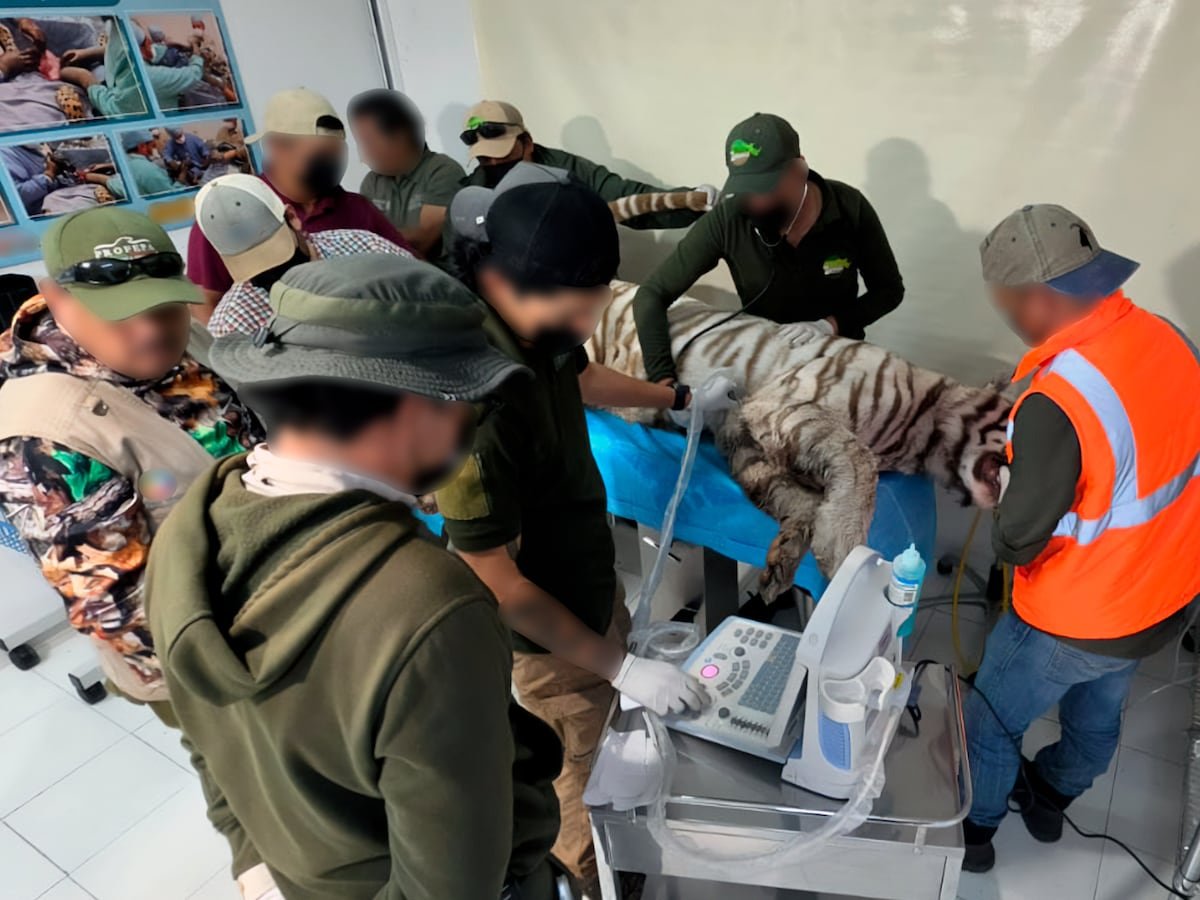
A resident of Tepetlaoxtoc called in the early hours to report that one of his horses had been attacked by the tiger. For more than four days everyone had been fearing the feline. Kenzo, a huge animal 18 months old and weighing 550 lb (205 kg), had escaped from a private wildlife facility after a “communication error” left the doors open. Since then he had been roaming the ravines of the State of Mexico.
For 100 hours dozens of authorities, dogs and thermal drones tracked him across steep, densely vegetated terrain so rugged that one can’t even ride there on horseback, only walk. At 6.30am on Thursday morning they found him deep in a ravine. The “containment operation” did not go as planned. Kenzo died after a police officer shot him when he was only about a meter from the veterinarian who had given him a sedative dart, according to Gustavo Ampugnani, director of Wildlife of the Secretariat of Environment, who says that “it was never fired to kill” and that the shot was to prevent him from leaping at the people trying to bring him back to the facility: “First priority is protecting the lives of people who are in danger. Unfortunately he died.” EL PAÍS reconstructs his final movements.
Since last Saturday, in between World Cup matches, news of the USMCA trade agreement and rescue operations in Venezuela, the image that kept recurring in Mexico was of a very white Bengal tiger lying in the undergrowth of the State of Mexico. The videos were captured by drones while the feline walked or lay calmly. Tepetlaoxtoc mayor Diana Morales asked residents to stay calm but also to close all doors and windows: “Above all, take extreme caution.” A tiger was on the loose.
There are no wild tigers in Mexico, and there are not many wild Bengal tigers left in the world—only about 4,000, the vast majority in India. They are a protected species. Kenzo was born in the state of Hidalgo at a private facility classified by the government as a PIMVS, licensed to have wild animals. At eight months old he was sold to Animal Experience, which is another PIMVS, or as they describe themselves: “a center for animal conservation and protection.” On the facility’s Facebook page, images of Kenzo bathing in a pond or rolling in the grass are still posted. That whole process was legal, the government tells this newspaper.
On Saturday afternoon Animal Experience staff entered Kenzo’s enclosure to prune a tree. A communication error during the exit and the entry of maintenance workers left the doors open—the tiger’s enclosure and the facility’s gates more generally. “It was a protocol error,” says Jorge Zapata, coordinator of the Environmental Protection Representation Offices of the secretariat.
Teams were quickly assembled to find him. Profepa, Civil Protection, public security officers, Tepetlaoxtoc municipal officials and ecological park staff formed a “search, rescue and containment” brigade. It was not easy. The terrain is rough and uneven, with dense vegetation and heavy rainfall. Using thermal drones to search for heat signatures, the brigade tracked Kenzo, tried to lure and sedate him with food without success, until the early-morning call from the neighbor about his horse.
Last movements
The Bengal tiger was deep in a ravine located about 12 miles (20 kilometers) from where he had escaped. The brigade split into different sections. In the end two operational cells of five people each remained, Ampugnani recounts after reviewing his notes. “We’re talking about an 18-month-old Bengal tiger, strong, robust, a highly dangerous species, that had been roaming for almost five days—we don’t know if it was feeding, possibly frightened,” the official says, summing up: “Very aggressive.” When they located him “they prepared to carry out chemical containment,” that is, to shoot sedative darts.
“When they were preparing for this, the tiger saw them and lunged at the veterinarian responsible for firing the sedative rifle, and the policeman next to him fired his service weapon toward the ground to scare the animal,” Ampugnani continues. “The animal retreated, but then turned, slipped into the bushes, disappeared from view and began to reappear behind these two people.”
The scene was a veterinarian and a police officer at the bottom of a ravine in the State of Mexico facing a Bengal tiger. They fired the dart. “But these darts take about five minutes to take effect. In the meantime the animal keeps advancing toward them. At just over a meter away the animal keeps coming and at that moment the police officer fires his weapon to prevent the tiger from pouncing on the veterinarian,” the director of wildlife surveillance narrates: “You have to act quickly when the danger is essentially imminent.”
After that shot — the Secretariat has not confirmed where it hit — the wounded tiger slipped back into the bushes. There the veterinarian fired more sedatives until Kenzo was “contained.” “The animal was still breathing; it was known he was wounded but not what kind of injuries he had. The entry wounds from .22 or .45 caliber rounds that these officers might have are very small for an animal with such thick fur and tough skin, so you don’t immediately see where the wounds are,” the official explains.
Kenzo’s death
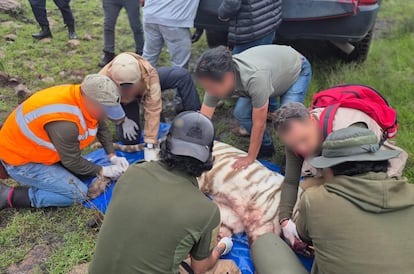
In the next 30 minutes they removed the tiger from the ravine and took him to the control post where a truck awaited to transport him. By then the rescue had already been announced as a success. Outside that area people in the media and on social networks were already celebrating having recovered the tiger without further harm. Then Kenzo died. “We presume the gunshot wounds caused internal bleeding,” Ampugnani says. Tepetlaoxtoc’s mayor’s initial reaction was to say that while he was in her municipality, before Profepa took him, “he had scratches but no life-threatening wound.” No one wanted to carry a young dead Bengal tiger—especially after announcing he had been rescued alive.
Officials recall Mexican rules that human lives must be prioritized. “You plan containment in an optimal scenario where you control everything. But if things get out of control, the first thing we are taught is to safeguard the integrity of the people there,” says the director of wildlife surveillance, who defends that the team that tracked Kenzo for more than four days “acted professionally in a high-risk situation”: “They are being sacrificed in the media and that is not fair.”
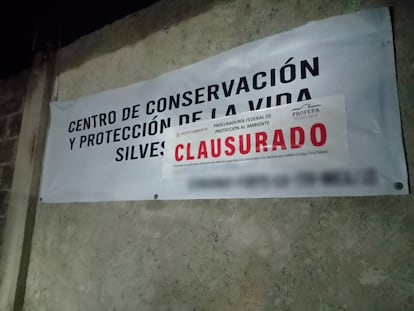
After an inspection, Animal Experience’s facilities have been shut down because they had “violated the management plan previously authorized by Semarnat.” The federal agency has taken custody of the other animals that lived with Kenzo: a Harris’s hawk, a spider monkey, a Morelet’s crocodile, two raccoons, a Burmese python, two jaguars and a black bear.
In Mexico there have been previous incidents of a similar nature: a tiger cub was seen wandering a mall in Polanco, and three emaciated tigers were abandoned by a cartel. Now the message is that Kenzo’s loss should raise awareness about managing these felines. “We have maintained a permanent campaign called ‘your home is not their home,’” Jorge Zapata explains: “To raise public awareness that these animals cannot live on private properties; they must be in their natural habitat.” One that, evidently, is far from the ravines of the State of Mexico.
Sign up for our weekly newsletter to get more English-language news coverage from EL PAÍS USA Edition