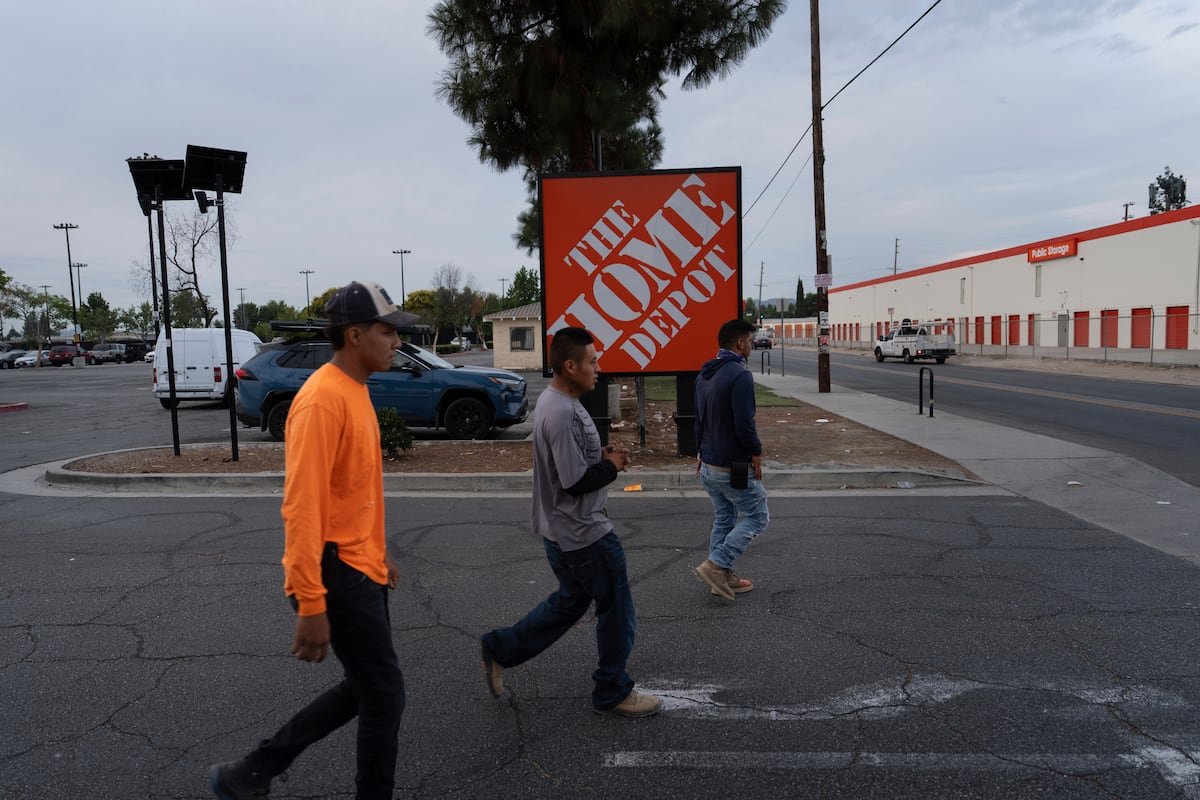
Erwin nearly ran out of the parking lot of a Home Depot store in Los Angeles. In front of him, a vehicle with tinted windows had stopped and a man in a black vest asked him: “Are you looking for a job?” He turned out to be a private security worker. “I thought they were ICE,” Erwin says in a nervous voice, alluding to the dreaded Immigration and Customs Enforcement agents. That morning, Erwin, who is from Guatemala, was on constant alert, keeping an eye on every vehicle that entered that establishment, which has become one of the main targets of immigration raids in the city.
Despite the risk, day laborers continue to come seeking work at this branch, located a few blocks from the skyscrapers of downtown Los Angeles. Many are undocumented and have only been in the U.S. for a few years. They stand at the store’s entrances and approach pick-up trucks loaded with materials, hoping to get a temporary job unloading in return for a few dollars. This practice, which has been going on for years, makes them particularly vulnerable to federal government operations.
“I’m scared, but I don’t have a single cent to buy food. That’s why I’m taking a risk, I have no choice,” says Erwin, 31, originally from San Marcos in western Guatemala, near the border with Mexico. “I have applied for jobs in several companies and they all asked me for work permits, which I do not have,” he adds.
Ever since he was fired from a recycling plant after they discovered he was undocumented, Erwin’s strategy has been to call everyone he knows to ask if they need help. It worked for a while, but he hasn’t earned anything for several days. Coming to this Home Depot store is a last resort. “We don’t know at what point ICE will arrive. They drive private cars,” he says. “Being here is a risk.”
More than 500 day laborers arrested
Day laborers are one of the main targets of the massive raids carried out in this city. There are dozens of videos on social media of ICE and Border Patrol agents chasing migrants in the vicinity and inside Home Depot stores. ICE even mounted an operation called the Trojan Horse, in which officers hid in a truck to enter the heart of a Hollywood branch. Their goal was to get as close as possible to the migrants and reduce the chance of a chase. More than 500 day laborers in Los Angeles have been caught in such operations since the beginning of 2025, according to estimates by the National Day Laborer Network (NDLON), which has no record of the numbers deported or of those making it out of the ICE detention centers.
“[In the past] the agents arrived in large numbers. They mapped the place; they blocked the entrances and exits so that, if someone ran in one direction, agents would be waiting for them. We have not seen that so much [lately], although it does not mean that they will not go back to that,” Pablo Alvarado, head of NDLON, tells EL PAÍS.
Alvarado explains that many day laborers are now caught at construction sites, as well as at traffic lights where, he says, racial profiling is used. “They see the driver and the van full of building material or gardening tools. That’s all they need to stop it,” he says. “They’re changing their tactics.”

Day laborers themselves have also changed the way they look for work. They seek work through networking and agree with contractors to be picked up at random meeting points. That’s why there are fewer day laborers hanging around Home Depot stores, Alvarado explains. “They have not disappeared or ”self-deported»; they are looking for alternative ways to survive. But when their economic situation becomes dire, they go back to the Home Depots. They are still looking for a way to make a living. What other option do they have? They take that risk.”
Benjamin Wood, who went from being an activist in a day laborers’ organization in Pomona to a defense attorney for migrants, agrees that ICE operations have moved away from Home Depots, but maintains that these workers are still in their crosshairs. One of his clients was arrested in what he describes as a “military operation” at a San Bernardino branch, while another was taken into custody inside a coffee shop. “ICE agents arrived at the donut shop; He was drinking coffee. They started interrogating the people who were there,” Wood says.
Those released from the immigration detention centers usually return to their routine and, in some cases, get caught up in another ICE operation. “There have been cases of people who are released, return to the corner to look for work and ICE agents detain them again,” says Wood.
Boycotts of Home Depot
Juan’s calloused hands tell of years working in construction. Each morning, he is strategically positioned at the corner of Wilshire and Union streets, where he can be easily spotted by contractors looking for temporary labor. That same corner allows day laborers to identify vehicles that could be ICE. “All day long I’m on the lookout,” he says. “If you relax, you’ll end up deported.”
Juan — not his real name — has been working independently for seven years and agrees that the last two have been hell. “There are nights when I don’t sleep for worrying. I dream ICE is chasing me, that no one gives me a job, that I go back to Mexico voluntarily but things go badly there.”
But Juan doesn’t blame the Home Depot chain, accused by some activists of remaining silent, and even of cooperating with ICE in the operations carried out in its facilities. “What can the store do? These people don’t ask for permission: they go in and take everyone,” says Juan. Among day laborers, opinions are divided over the calls to boycott Home Depot. Some, like Juan, refuse to rise up against the place where they still find work.
Home Depot has been under pressure since the raids intensified. Several campaigns have emerged to support the day laborers. One of them, called “Adopt a Day Laborer Corner,” invited volunteers to go with their cell phones to the places where day laborers congregate to document possible ICE operations and provide the migrants with support. More than 200 people responded to the call. Another initiative has asked customers to stop shopping at the chain. “At the same time that there has been an unprecedented systematic persecution of day laborers, there has also been a lot of solidarity,” says Alvarado.
Another mobilization occurred in a store in Monrovia at the end of 2025. A number of activists came to buy an ice scraper that cost 17 cents and then returned it. The protest was called the ice scraper protest. This caused the payment and customer service lines to collapse for almost an hour. Protesters also marched through the aisles. Management had no choice but to close the store, something that activists interpreted as a sign that the corporation could take similar measures when federal agents arrive.
Far from closing its doors to ICE agents, Home Depot closed them to day laborers and expelled them from its facilities, citing an old rule that prohibits the offering of services on its premises without authorization. The company claims that it cannot do anything to prevent the raids. “We are not notified when immigration enforcement activities will take place, nor do we participate in such operations. We do not coordinate actions with ICE or the Border Patrol,” Home Depot said in a statement to EL PAÍS.
The company believes that immigration agents do not need a court order to enter and detain undocumented immigrants “since our stores and parking lots are publicly accessible.” It denied that it is sharing the information it obtains from the license plate readers in its parking lots with the authorities. It has ordered its staff to stay out of ICE operations: “Legally we cannot interfere.”
“If the situation doesn’t change, I’ll go back”
Being a day laborer in the U.S. was never in Erwin’s plans. In early 2020, when he quit his job as a delivery driver in Guatemala and said goodbye to his wife and two young children, he imagined that a more bearable life awaited him. At first, luck seemed to be on his side in California. He found a job as a tractor driver at a recycling plant and worked his way up to earning $1,400 a week — working from Monday to Sunday. With that money, he was able to save to pay the $16,000 charged by the gang of traffickers who brought him to Los Angeles and also to buy a car and a plot of land back home where he built a house.
Erwin felt that the sacrifice had been worth it. Until everything fell apart. The agency involved in his hiring discovered that his Social Security card was fake, and he was fired. When Donald Trump returned to the White House, Erwin ended up losing what he had gained. Formal employment was off the table, and he was unable to pay the $375 monthly rent on an apartment he shared with two other migrants, who threw him out. He now sleeps in an abandoned wagon in a dirty alley in South Los Angeles. Every day he goes to two churches in the area for food. He is homeless. Two months ago, he sent his wife in Guatemala his last $300. “I tell her to be patient and that, in time, maybe I’ll have a steady job,” he says.
Erwin’s situation drove him to seek work at the Home Depot store most targeted by ICE agents. “I know it is. I’ve seen it on the news. In the first operation, several day laborers were taken. That’s where they caught a lady who sold tamales,” he says, pointing to the main entrance of the branch. Erwin approaches customers to offer services that cover refurbishments, carpentry and plumbing. But recently, the only answer he gets is no. “I never imagined that the situation would get the way it is now, but, as the saying goes: the ‘never’… eventually arrives.”
A few days ago, Erwin’s wife called him to ask for money to buy food for their children and cover other outstanding expenses. His eldest daughter, 11, came on the line and asked, “When are you coming, daddy?” The question left him speechless. Erwin’s feelings are mixed. The idea of self-deporting to Guatemala, which he left to help his family, has begun to reverberate in his head. “If the situation doesn’t change, I’ll go back to my country,” he says.
Sign up for our weekly newsletter to get more English-language news coverage from EL PAÍS USA Edition