At 11:10 p.m. on an unusually freezing night in late January, the last commercial flight from Houston, Texas, landed at La Aurora Airport in Guatemala City. Passengers and their luggage were immediately unloaded. Just when it seemed everyone had left, the cargo hold door opened and airline staff pulled out two white cardboard boxes. Inside, two coffins.
Julio González, 59, import supervisor at Combex-IM, the airport’s customs warehouse, oversaw his team’s respectful transfer of the remains in a small forklift to a chapel illuminated by a cross. Papers affixed to one of the two coffins revealed the name of its occupant: Miguel Raymundo Raymundo, 36, who died on January 14, 2026, in the United States.
Miguel is one of the hundreds of Guatemalan migrants who die each year in the U.S. due to accidents, illnesses or homicides, and who are repatriated thanks to the perseverance of their families as the final act of a migratory journey that ends where it began.
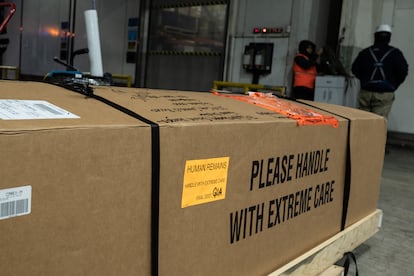
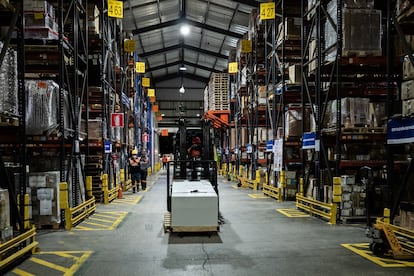
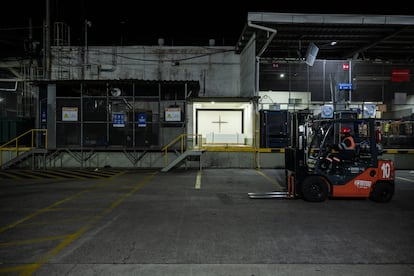
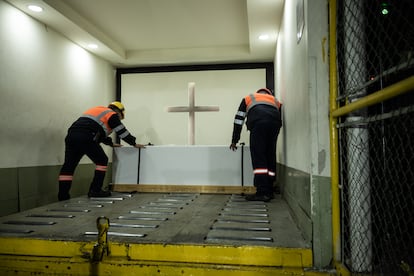
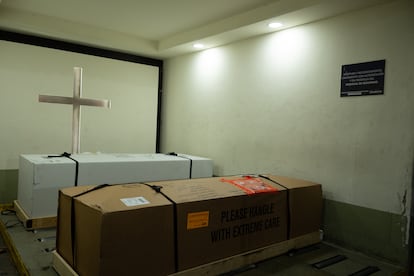
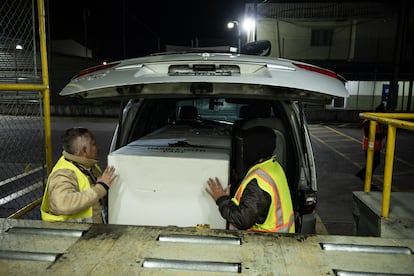
In 2025, 2,443 people who had died overseas arrived by air at Combex-IM, almost all from the U.S., according to data from the customs warehouse. “Just today, 10 coffins arrived,” says González, who has worked there for 33 years. “In Guatemala, migration is constant. Just as many people leave, many return. Sometimes in a coffin,” he adds.
More than one million people born in Guatemala live in the United States, according to the most recent data from the Guatemalan Ministry of Foreign Affairs. However, this figure may be underreported because some Central American migration is irregular. Under the current deportation policy of the Trump administration, 4,941 Guatemalans were deported in January alone, an average of 159 per day.
At 2:30 a.m., after completing the administrative procedures, Luis Felipe Álvarez Oviedo and Roberto Herrera from the Landívar funeral home loaded Miguel’s heavy coffin into a minibus. As they left the Combex-IM bus terminal, Herrera crossed himself before driving off, out of respect for the passenger and to ask God for a safe journey through the mountains of Quiché until they arrived in Nebaj, the town where Miguel was born. Tenam, in his native language. Despite having lived in the U.S. for 18 years, Miguel remains a member of the Ixil Maya people.

A dignified return
At 8 a.m., the minibus arrives at the first gas station marking the entrance to the town. About 50 people are waiting there in the back of several pickup trucks, along with the municipal police and a vehicle blasting music. From there, the convoy begins its journey to the house.
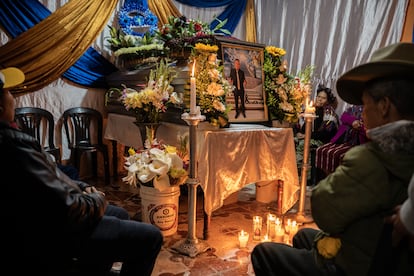
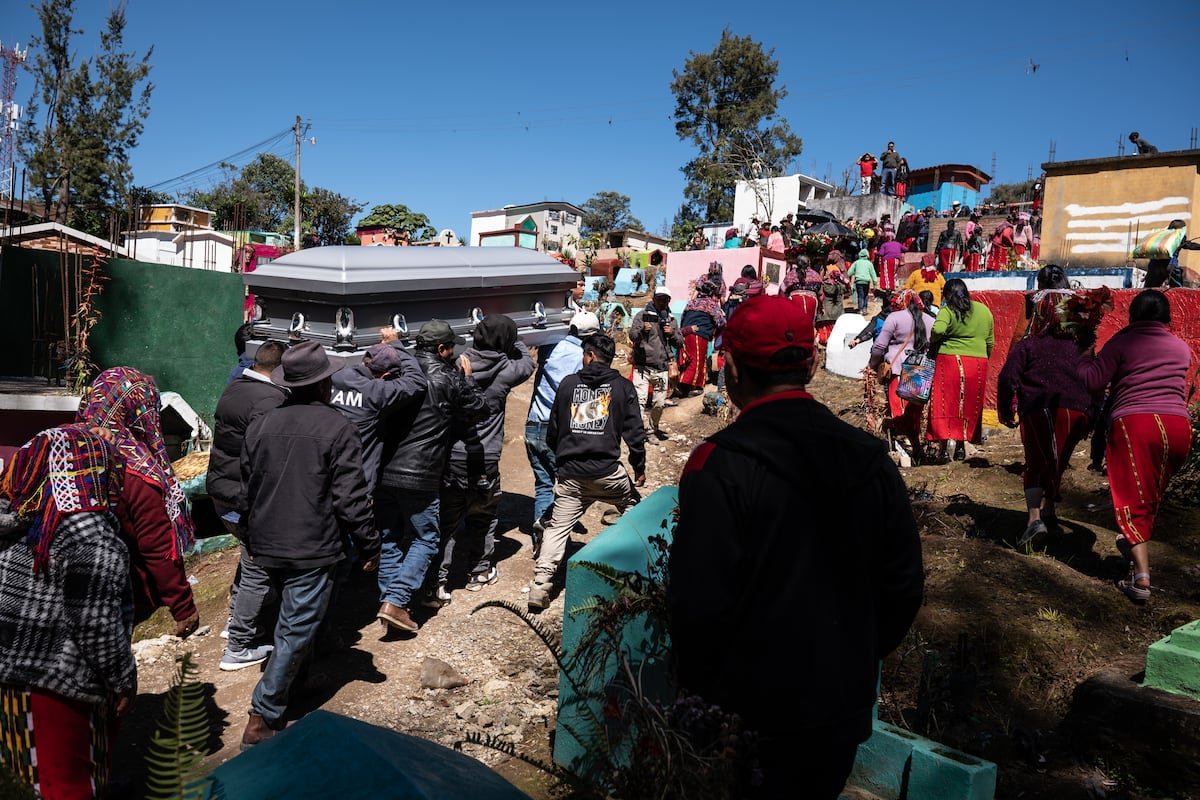
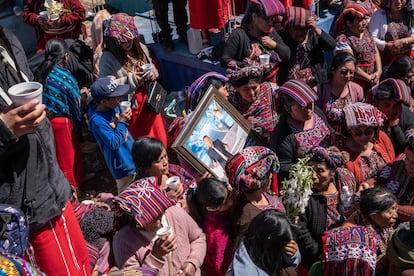
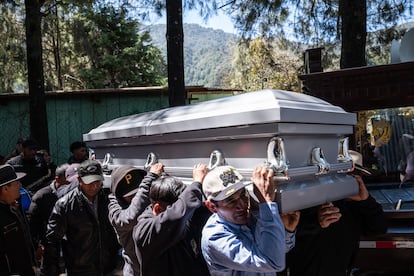
Upon arrival, family, friends, and neighbors, cell phones in hand to record the moment, opened the back door of the minibus, took out the coffin, and carried it on their shoulders to Miguel’s parents’ house, which had been transformed into a makeshift chapel. Thus began a 24-hour wake, filled with nostalgia, three meals, prayers, mariachi music, and photos of his life in the U.S. projected on a loop. A stylish return for Miguel.
“My uncle was the pillar of this family,” says Willy Raymundo, his 24-year-old nephew. “He went to the U.S. when he was about 18, and from there he helped us all. This funeral will be unforgettable because we want to publicly celebrate his efforts.” Willy cries as he says goodbye to the man who took him in when he was orphaned and allowed him to migrate at age 14 so they could live together for a while.
Like thousands of Guatemalans, Miguel Raymundo Raymundo went north for economic reasons. He worked in the restaurant industry, started a family, and then illness struck. Lung cancer left him no way out. “He supported my grandparents,” Willy continues. “He always said he didn’t want us to spend money to repatriate him, but my grandparents couldn’t survive without seeing him after almost 20 years. He had to return to his homeland. It’s part of our culture.”
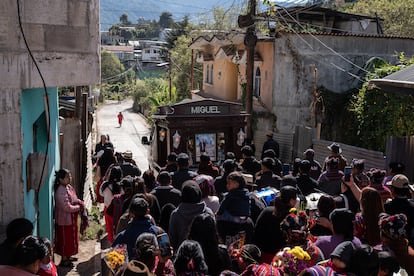
Remittances are one of the most important sectors of Central American economies. In Guatemala, they represent around 20% of GDP, and in Honduras, Nicaragua, and El Salvador, they approach 27%. The death of a breadwinner in the U.S. is an emotional loss, but also an economic one.
Miguel understood his parents’ wishes and paid for his repatriation while he was still alive. “He said, ‘when I die, I’ll leave all the expenses paid.’ And so it was,” Willy concludes, before joining the procession behind the hearse.
Bureaucracy and costs
On the other side of town, Juana Bernal also recently repatriated her niece, María Elena Corio Bernal. She was 13 days old when she died on December 9, 2025. Her body arrived in Nebaj a month later, where she was received by her grandparents and aunts and uncles. Her parents, undocumented workers in the U.S., couldn’t accompany her. Leaving meant they wouldn’t be able to return. “They suffered terribly, but they know that one day they’ll come back, so it’s better that the little girl is here now,” Bernal says. “We had to take up a collection with family and neighbors to cover the $6,000 for the repatriation from Florida,” she adds.
In her hands she holds the medical report with the cause of death: total necrotizing enterocolitis, a disease that primarily affects premature newborns like María Elena. Everything is written in English. “I didn’t even understand what she died of,” her aunt murmurs, looking at the floor.
When a migrant family member dies, the human tragedy is compounded by an economic and bureaucratic puzzle involving autopsy, death certificate, embalming, transport permit, and the apostille that confirms the authenticity of the documents. All of this is handled first by a funeral home in the U.S. and then by another in Guatemala. “Private repatriation can cost between $8,000 and $13,000, depending on the state where the death occurred, and takes a minimum of 15 days,” explains Álvarez Oviedo. This expense can plunge entire families into debt, especially in Quiché, where 86.4% of the population lives in poverty.
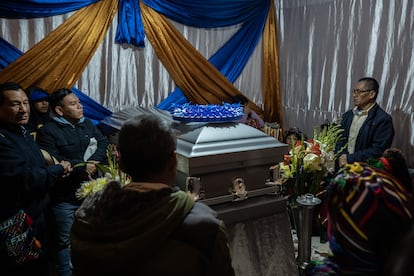
For years, the local organization Asaunixil has provided free support in the procedures and in the grieving process to those families in Quiché who, due to not being familiar with the process, are exposed to scams.
“There used to be funeral homes that inflated prices, thinking the family in the U.S. had money,” says Francisco Marroquín, director of Asaunixil. “Now we have it more under control, but I always say that there are coyotes [human traffickers] who will take you alive, and also coyotes who will take you dead.»
Scams are lurking around every corner. “I’ve seen funeral homes send fake death certificates. It’s a key document, and the family has to pay again to request a replacement,” explains Álvarez Oviedo.
Furthermore, especially during the holiday season, airlines prioritize commercial cargo and relegate bodies to a secondary role, sometimes leaving families in limbo. “They delayed the little girl’s arrival twice. Everything was ready for the wake. It was very hard,” recalls Juana Bernal.
There used to be funeral homes that inflated prices, thinking the family in the U.S. had money
Francisco Marroquín, director of Asaunixil
If families cannot afford the expenses, as of 2011 they have been able to turn to the Ministry of Foreign Affairs’ Repatriation Fund, which, with an annual budget of five million quetzales (around $655,000), covers costs ranging from $1,000 to the full amount. “We provide support to help our citizens return home in a dignified and safe manner,” explains Ricardo Girona, director of Consular Affairs. “The program applies only to fully identified individuals who died while undocumented, without support networks in the United States, and with low-income families,” he continues. On average, the fund covers more than 300 repatriations per year, although in 2025 these numbers dropped to 201: 169 from the United States, 31 from Mexico, and one from Europe. “Trump’s fear-mongering rhetoric has led to a drastic decrease in migration, which is reflected in a reduction in deaths,” Girona concludes.
However, between November and January, the process often stalls due to the freezing of funds at the end of the year. The family of Julio Habram, 34, who died on November 16, 2025, and has yet to return, knows this all too well. “The family tried to apply for the fund, but, given the delay, the community is raising money to bring him back now,” says Marroquín.
Dying without papers
Julio was killed in a hit-and-run in the U.S. “Most die in road accidents and often while in an irregular immigration situation,” explains Álvarez Oviedo.
However, in the morgue, the hospital, or the funeral home, the undocumented migrant becomes visible. The death certificate is often their first valid document in the U.S. “Seeking justice for migrants who die in accidents is impossible,” Marroquín says with frustration. The complaint must be filed by a family member in the U.S., almost always also undocumented. “If they go to the police, they are deported. There is never a conviction or financial compensation,” he adds.
Paradoxically, even a U.S. death certificate isn’t enough. Until it’s canceled in the civil registry, the person isn’t considered legally dead in Guatemala. “This process can take months,” Marroquín concludes.
The match
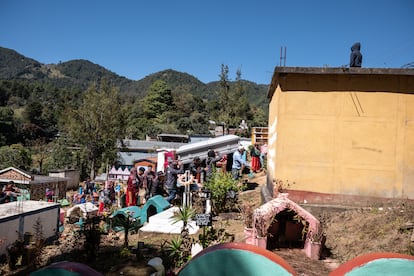
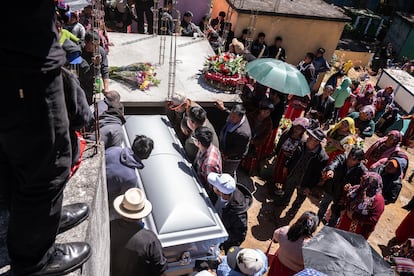
As Miguel’s hearse moves through the Nebaj cemetery, journalist Mario López, from the Megavisión news outlet, broadcasts the burial live on Facebook. “Family members in the U.S. request this service so they can participate from afar,” he explains, as he walks ahead among the burial mounds.
Like the mother of María Elena, the deceased baby, many relatives are also undocumented migrants and have to experience grief through a screen.
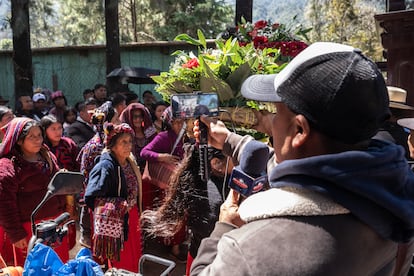
“When a person is far away, it seems as if they haven’t died. If I hadn’t seen him, in my mind he would have lived forever in the USA,” Willy says with a tender smile as he remembers his deceased uncle.
During the burial, people still inhabit the cemetery. Some eat bread to stave off hunger, others drink soda sitting on the mausoleums. “You know what? You can leave the town, but the town doesn’t leave you,” says a man before adjusting his hat and walking away under the midday sun.