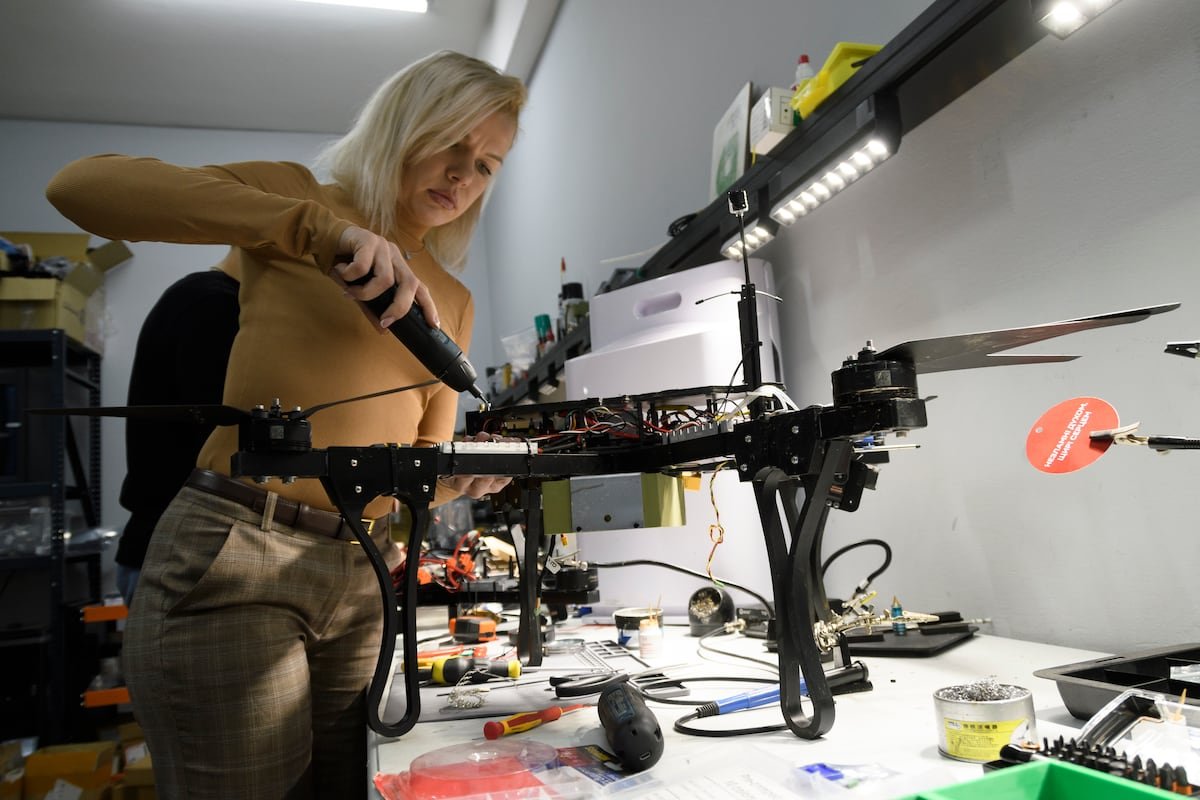
Oleksandr Hrachov knows what it’s like to be on a battlefield. When the Russians attacked Crimea in 2014, later annexing it, this Ukrainian engineer volunteered for the army to fight against the separatists at Donetsk Airport in eastern Ukraine. “Yes, I was one of the cyborgs [soldiers known for their fierce resistance against the separatists] and I fought to defend our land,” he says. “When the Russians surrounded us, it was necessary to find a quick solution for aerial reconnaissance. That’s how the idea of using drones in warfare came about.”
That experience was the catalyst for rethinking military technology, paving the way for innovations like drones, now cornerstones of modern industrial capacity. Under this premise, TSIR was born, an unmanned aerial vehicle company that, after partnering with the Finnish firm Summa Defence, is developing a strategic line of aircraft to supply NATO countries. “I would have liked to have founded a company that manufactured peace in the world, but the war that came to my home left me no other option. We didn’t choose war. War chose us,” Hrachov says.
Ukraine has become one of the world’s leading drone producers. According to Bloomberg estimates, the country produces around four million drones annually, compared to the 100,000 manufactured by the U.S. industry, the most powerful in the world. For security reasons, Hrachov prefers not to disclose the details of his drone production. “Believe me, it’s a significant number, and it’s growing exponentially,” he says.
And it will continue to increase. “Today we see a continued escalation by Russia, despite all attempts to reach a peace agreement. We observe examples of increasing local aggression in different parts of the world and a general increase in global tension. All of this is driving the development of drones. That’s why, in 2026, 2027, 2028, and beyond, drone production will grow exponentially.”
What he does share is his concern about the dependence on critical materials. “The manufacture of modern drones — especially for military and defense applications — depends on technologically complex components that require specialized mineral resources (lithium, nickel, graphite, rare earth elements such as neodymium or dysprosium),” argues the Ukrainian engineer. For example, these elements are used extensively in motors and sensors that ensure the high efficiency of unmanned systems.
Beneath the advanced architecture of drones lies a critical dependence on raw materials essential to Europe’s security. Every component, from motors to batteries and sensors, requires specific metals that cannot be substituted without compromising quality. For example, motors use rare earth elements to be powerful and compact, while batteries rely on lithium and cobalt, according to a Rabobank report. Similarly, gallium and arsenic are key for secure communications, and other minerals like indium enable thermal cameras to function correctly.
The main problem is that most of these resources are located outside the European Union, limiting its ability to make independent defense decisions. “China controls between 70% and 90% of the rare earth market needed for battery materials. This creates a serious dependency in defense and drone manufacturing supply chains worldwide,” says Hrachov. “In general, global supply chains are concentrated in the hands of a few large players, which poses risks to the continued production of Western and Ukrainian manufacturers.”
Training specialists
But beyond raw materials, another major challenge for Europe and the world, Hrachov notes, remains the lack of human resources. “Europe must invest in training top-level specialists in the manufacture, use, and integration of unmanned systems into modern militaries or new defense alliances,” he explains. In his view, funding is needed for FPV (First Person View) pilot schools, for those who use special goggles that display in real time what the drone’s camera captures, for engineers, and for all the supporting infrastructure.
“A pilot must be trained and educated, and then their knowledge and skills must be constantly updated to meet new challenges, technological advancements, and evolving battlefield conditions,” he says. “Drones are manufactured and evolve much faster than people can learn to manage the architecture of the battlefield.”
He adds: “Training a pilot or an engineer requires not only money but also time. Our enemy has people, resources, and money — everything necessary to carry out aggressive policies, aggressive provocations, hybrid warfare, and large-scale combat operations on the territory of another state. Today it is Ukraine. Tomorrow it could be a member of the EU or NATO.”
Sign up for our weekly newsletter to get more English-language news coverage from EL PAÍS USA Edition