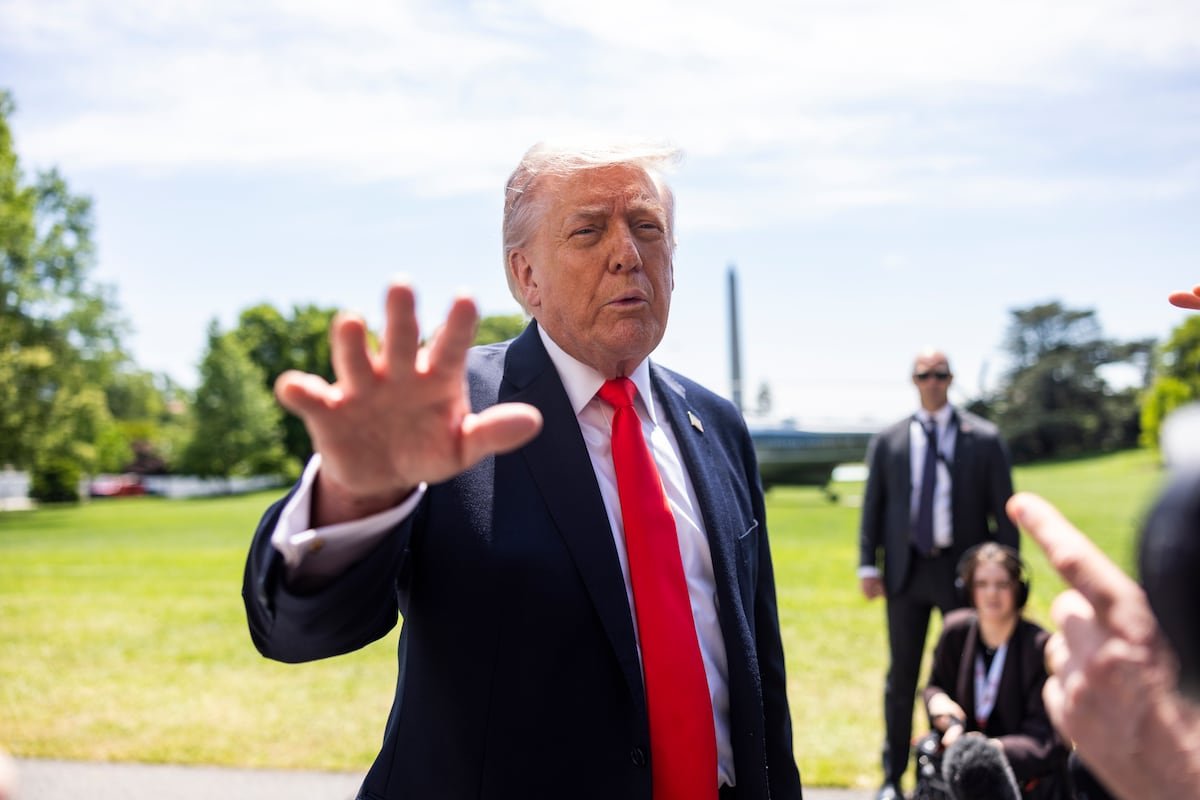
For Donald J. Trump, 2026 was a year full of promise. It began in the early hours of January 3 with a spectacular barrage of fire over Caracas. After months of anticipation surrounding the deployment of the fleet in the Caribbean, the capture of Nicolás Maduro scored a point for him, demonstrating his military’s ability to succeed in complex missions. That same day, he announced a new era of the Monroe Doctrine. Hard power was back. But there was something more important: the prospect of starting an election year on the right foot, carefully managing that success, and trying, in the meantime, to stabilize the economy in the lead-up to the midterm elections in November.
But, in reality, it wasn’t his best January. In the middle of the month, massive citizen protests had begun in Minnesota in open revolt against his immigration policy. Thousands of miles away, in Davos, another revealing scene unfolded. Canadian Prime Minister Mark Carney declared that the old rules-based international order was dead and the world was entering a new one, governed by the coercion of the great powers. To survive, it was necessary to organize the middle powers. He said this before billionaires and heads of state — with Trump at the same event — and received a thunderous ovation that exposed his neighbor as the driving force behind this demolition.
Several weeks passed in this way. In his State of the Union address, Trump boasted of having led his country into a new golden age in which inflation was plummeting, gasoline was cheap, drug trafficking from the south had been reduced by more than 50%, and “illegal” immigration was at ridiculously low levels. Beyond its borders, the United States dominated the global stage with a policy of peace through strength. Even then, 2026 might have seemed like an annus mirabilis. But the U.S.-Israeli war against Iran has blown his grandiose fantasy of a golden age into smoke.
Trump’s administration currently has a 67% disapproval rating among Americans. His cabinet has been plagued by scandals and seems to be operating in complete chaos, with abrupt firings and appointments. The MAGA movement, which has supported the Republican through thick and thin, has begun to fragment into a myriad of factions, some of which are waging open warfare against him. Last week, he survived a third assassination attempt. A few days later, Charles III, King of England and head of the nation that has been the United States’ greatest historical ally, offered veiled criticisms ranging from the separation of powers and environmental protection to the war in Ukraine and the need to preserve NATO. With British phlegm, Charles III emphasized before Congress the importance of democratic, legal, and social traditions. It was a transparent jab at Trump’s ego. It could be translated as follows: the executive power must accept living surrounded by limits: governing is not reigning: a president should not behave like a monarch nor aspire to be crowned.
Although the visit was meant to be a respite amid a deluge of bad news, it culminated in an awkward image: the first lady visibly tense at a gala, trying to wriggle free from her husband.
The path ahead for Trump is fraught with difficulties. Negotiations with Iran are frozen. There is no way to unblock them without making significant concessions to the ayatollahs or escalating the war, something most Americans do not want. As a result, oil prices are likely to remain above $100 for some time, further fueling discontent. German Chancellor Friedrich Merz delivered another blow, stating that the United States has no exit strategy in this conflict. He added: “An entire nation is being humiliated by the Iranian leadership.” Trump’s threat to withdraw U.S. troops from Germany in retaliation for Merz’s criticism is sadly typical and typically childish. When there is no strategy, improvisation reigns.
Shortly before his death, the renowned statesman Joseph Nye, who coined the term “soft power,” stated in an interview with EL PAÍS that Trump could “destroy America’s global appeal.” He was referring to everything an empire like America can obtain from others peacefully, without resorting to force: its power of seduction. That prediction has now come true. In a year and a half in office, the president has alienated many of his historical allies, destroyed the esteem his country enjoyed among many nations, and weakened its position as a benchmark of a system that, with all its asymmetries and flaws, prevented the international order from being governed solely by the law of the strongest. Losing soft power makes hard power less tolerable.
Recently, an article by Andreas Kluth for Bloomberg drew attention to this loss of soft power. According to Kluth, there has been a retreat of U.S. influence in fields such as higher education and the entertainment and technology industries, like Hollywood and Silicon Valley. This soft power, through which the United States dominated the world stage for decades, now faces formidable rivals in Europe and Asia, who are gaining ground every day in the race to shape “global notions of good and bad, of what is cutting-edge and what is backward.” The key to the U.S. image change is a government that has managed to strip away the enormous symbolic and cultural capital that the country once enjoyed.
“Many of these trends,” Kluth argues, “predate Trump’s second term but are accelerating because of it. There is no good measure of soft power, but those that exist indicate that the U.S. is losing it faster than any other nation. The U.S. as a brand used to be cool. Increasingly, it has become toxic.”
All of the above will be further accelerated due to the image of decadence that Trump projects to the world.
If his year began on January 3, it could end abruptly on November 10 with the midterm elections. The most reliable polls indicate that Republicans could lose both houses of Congress. What promised to be an annus mirabilis is increasingly shaping up to be an annus horribilis.
Inside and outside the U.S., Trump has ceased to be just a controversial leader and a quarrelsome bully, becoming, in the eyes of many — starting with his own party — something simpler and more dangerous: a toxic asset.
Nothing is set in stone, of course. If any politician has enjoyed almost supernatural luck, it’s Trump. More than once, he’s risen from the ashes. But even the best of luck has its limits. And all indications are that his’ is beginning to run out.
Sign up for our weekly newsletter to get more English-language news coverage from EL PAÍS USA Edition