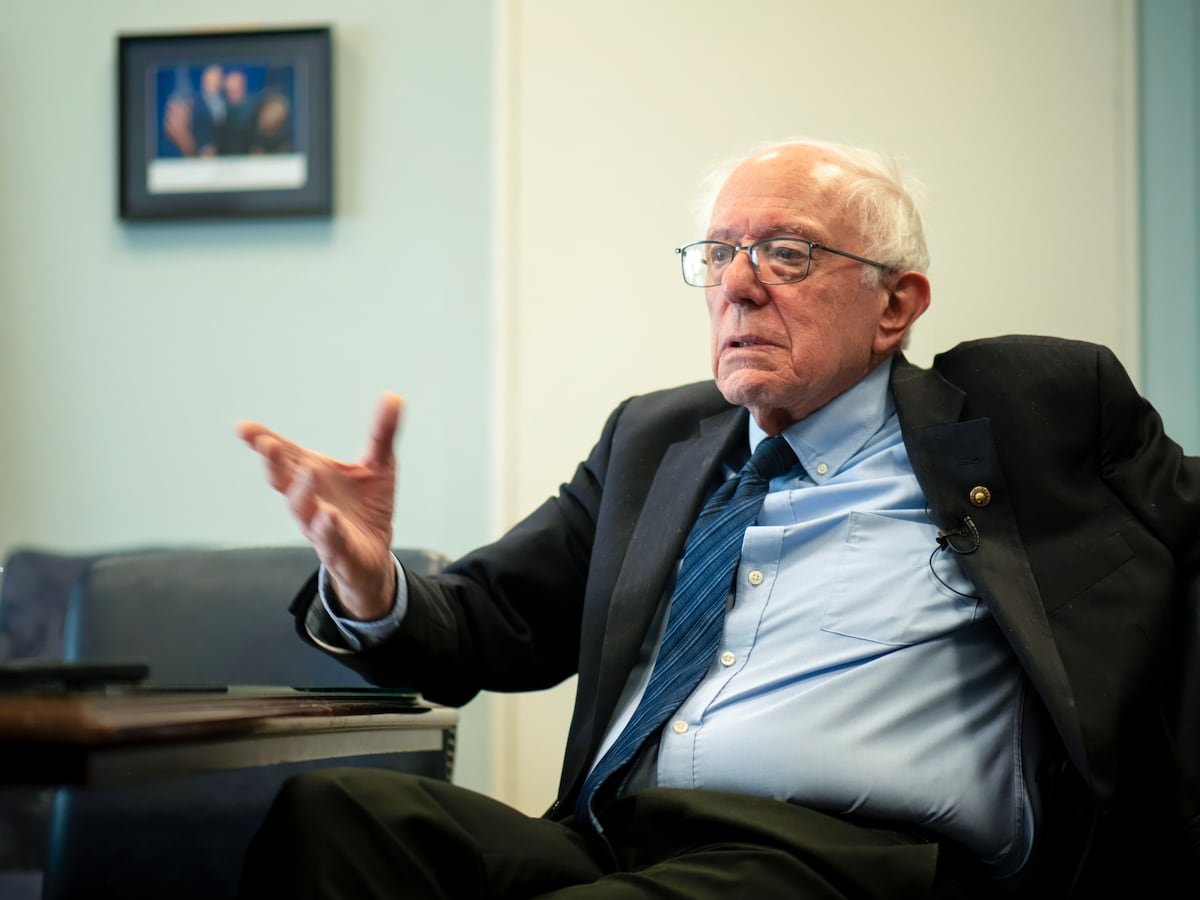
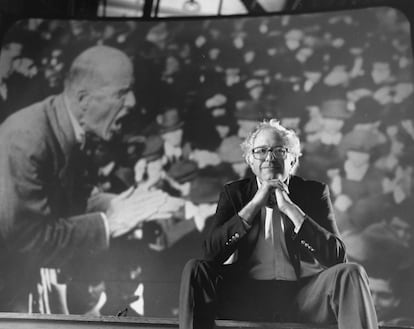
A black-and-white photo with Reverend Jesse Jackson and a portrait taken alongside Joe Biden, signed by the former Democratic president, hang on the walls of the office where independent senator Bernie Sanders received EL PAÍS last Wednesday at the Capitol.
Another day; like every day for over a week, the city woke up blanketed in snow. Also, as it has for a year, it did so awaiting the latest shock from U.S. President Donald Trump. This time, the Republican magnate had asked his party to strip the states of their constitutional right to organize elections in time for the November midterms, in which a third of the Senate, the entire House of Representatives, and the viability of the second half of Trump’s second term are at stake.
It has been just over 12 months since Trump returned to the White House, and 10 years since the extravagant campaign in which Sanders could have been the candidate to face him in an election that, like few before it, marked a turning point in U.S. history. Some of his compatriots — especially among his legion of young supporters — continue to wonder what kind of country they might have been left with if the Democratic Party had opted for Sanders’ progressivism and his message in defense of the working class, rather than the establishment candidate, Hillary Clinton.
Two elections and one Trump victory later, Sanders retains his aura as an icon of the global left. He is 84 years old, with a deep voice, an elusive gaze, and an unmistakable way of mulling over his words. He was mayor of Burlington, the most populous city in his home state of Vermont, on the border with Canada, and has been in the Capitol for 35 years. First, he served as a member of the House of Representatives between 1991 and 2007, and he has just begun his fourth (six-year) term as senator for Vermont.
He has hinted that this term will be his last. If he keeps that promise, he will retire having at least ensured that his legacy will live on thanks to young figures such as Congresswoman Alexandria Ocasio-Cortez and New York Mayor Zohran Mamdani. Both are among the most prominent progressive politicians on the U.S. left, and both stepped forward inspired by Sanders’ 2016 campaign and under the umbrella of the Democratic Socialists of America, a rapidly expanding organization in a country where not so long ago “socialist” was a dirty word.
A man who gives flattery short shrift, Sanders’ week had begun on Capitol Hill with a new, and very brief, partial government shutdown, which was resolved Tuesday after Republicans gave in on the Senate floor and removed from the budget a bill that would have dramatically increased funding for the Department of Homeland Security and, with it, the money for Trump’s brutal campaign against immigration. It is a battle that the senator has taken personally and is currently being fought on the streets of Minneapolis, where federal agents killed “in cold blood,” Sanders recalls, two defenseless U.S. citizens, Alex Pretti and Renee Good, detained protesters, and arrested a five-year-old child.
Through events in Minneapolis, Democrats suddenly find themselves winning a debate — on immigration — that until recently was poisonous for them. This image crisis for the White House has also opened the door for Congress — after a year of induced coma — to establish new rules for Trump’s immigration policy, the president having demonstrated an unprecedented passion for governing, with the acquiescence of his party, while turning his back on the legislative branch.
Question. A couple of weeks ago, Trump marked one year since his return to power. How would you describe those 12 months, that at times have seemed like an eternity?
Answer. Trump is the most dangerous president maybe in American history. We are the longest standing democracy in the world, going back to the 1770s where Americans overthrew the British Empire to create their own country, with a strong Constitution and a strong Declaration of Independence. Tragically for this country, Donald Trump is an authoritarian. He is an oligarch, whose view of the future is a small number of incredibly wealthy people getting even richer and moving the United States toward an authoritarian society. We are very alarmed at what Trump is doing domestically and to America’s presence internationally as well. Many of us are fighting back as best we can, and I think we are succeeding in the sense that Trump’s popularity is declining every single day.
Q. If anything has defined his second term so far, it is his determination to expand executive power, but it seems that the legislature has not been able to defend itself sufficiently…
A. You’re quite right. What Trump has done is undermine democracy and our Constitution. Trump has tried to usurp the powers of the Congress, legislation that we have passed, money that we have appropriated, he has illegally terminated. He has, in an unprecedented way, said states that voted against me are not going to get federal funding. It’s totally outrageous, and illegal. He is attacking the courts, picking and choosing what decisions he will obey. He is going after universities who teach courses that he doesn’t like, and he is going after the media with intimidation and lawsuits and by having his billionaire friends buy them up. There’s Mr. [Larry] Ellison, who now has significant power over TikTok and has acquired Paramount, which owns CBS. You’re seeing a handful of oligarchs controlling American media, the economy, and, because of our corrupt campaign finance system, our political processes as well.
Q. Is the system you describe prepared for three more years of Trump?
A. I hope so. Republicans control the House of Representatives by a tiny majority. They control the Senate. My hope is that in the [November] midterm elections, Democrats will regain control over the House. I think it’s a real possibility; if the election were held today, I believe that would happen. And there is a more distant possibility that Democrats could win the Senate. If that happens, then we will be able to hold back a lot of what Trump is doing.
Q. What should be at the top of the Democrats’ agenda the day after the elections, if they regain the House? Are you in favor of impeachment?
A. I don’t think so, but I don’t know the answer. I haven’t discussed it yet, but what I do know is impeachment will not succeed, because you need two thirds of the Senate. People must regain confidence in democracy, and they cannot regain confidence in democracy unless their government is working for them. In the United States, when 66% of the population are living from paycheck to paycheck, when millions of people earn poverty wages, when people can’t afford healthcare, education, housing, we have got to show the American people that we can deliver for them with a strong pro-working class agenda.
Q. It seems that what they call the American experiment is a building with weak foundations, which was not designed for the arrival of someone like Trump. What major reforms would this building need?
A. We have never seen a president who has displayed such contempt for the rule of law. You can’t have a democratic society where you don’t obey the law. There are very strong differences between the left and right, but nobody has ever questioned the results of an election. Trump is changing the rules of the game. But his opponents are working hard to prevent this, including through legal means. The courts are doing the right thing in defending the Constitution. At the end of the day though, it is going to have to be the American people who say no to authoritarianism in this country. We have been fighting authoritarianism and tyranny for 250 years. And I think there is a deep sense, even among people with different political views, that we do not want a kind of dictator running this country.
Q. Seeing the revelations from the Epstein files, one gets a feeling of peeking into the closed-door dealings of that oligarchy you criticize. They acted with impunity, and they have still not suffered any consequences. More people have been brought down by this scandal in the United Kingdom, for example, than in the U.S. Why is that?
A. First and foremost, it is disgusting beyond words that anybody would exploit young girls the way that Epstein and his friends did. That goes without saying, it is beyond disgusting. Secondly, it shows that if you are rich and powerful, you live in a different world and play by a different set of rules. If your kid robs a store, he ends up in jail. But if you are a billionaire and do terrible things to children… well that’s a different story. The Epstein case is further proof of the incredible power of the billionaire class in political life. And it doesn’t matter if you’re liberal or conservative, Democrat or Republican. His emails show that in those spheres of power, that’s beside the point.
Q. It seems like everything is for sale in this country, including — since the Supreme Court ruling in the 2010 Citizens United case, which altered campaign finance laws — elections. How would you explain this to a foreigner?
A. It is maybe the worst Supreme Court decision in American history, because what it does is undermine American democracy. The First Amendment protects freedom of speech. What the Supreme Court said is that if you’re a billionaire, you could spend as much money as you want through a Super PAC to buy an election. That’s your freedom of speech. That’s how Elon Musk contributed $290 million to elect Donald Trump, and I suspect Musk will now spend tens or hundreds of millions in the midterm elections. Other billionaires, mostly Republicans, but some Democrats as well, will do the same.
Q. Do you have any advice for combating the anxiety caused by the news coming out of Washington every day?
A. I want to reassure Europeans. It’s true that Trump has a very loyal following, I estimate 30% of the American people. They are authoritarian-minded and like the idea of a strong leader; Europe is familiar with that phenomenon. But a majority of Americans — not a monolithic majority, but a significant plurality — strongly oppose what Trump is doing.
Q. But they voted for him…
A. Trump didn’t win the election because people wanted him to invade Denmark or attack Venezuela, or to cozy up to Saudi Arabia or the UAE. They voted for him because the working class in this country is really struggling. Millions of Americans cannot afford to go to a doctor when they get sick. Almost a third of our population is either uninsured or underinsured. We’re dying at a younger age than people in Europe, it is very expensive to go to college, people can’t afford childcare and housing costs are extremely high. One of the reasons that Trump has been successful is that working class people have looked to the Democrats, and the Democrats have not really delivered for them. So what many of us are doing — Alexandria Ocasio-Cortez, Zohran Mamdani, and others — is trying to transform the Democratic Party to a party of the working class prepared to take on the oligarchs. And I would say to our friends in Europe, be very wary about the power of Elon Musk and a handful of other oligarchs. They want it all.
Q. The richest man in the world has already shown his interest in influencing European countries by supporting far-right parties, and the National Security Strategy warned in December that the government is also willing to cultivate these ties…
A. Musk is now funding right wing parties all over the world, while Trump is supporting his friends in Latin America. It is a coming together of the billionaire oligarchs with right wing extremist parties who do not believe in democracy. You cannot have democracy when you have a few people with so much wealth and power. Musk is investing huge amounts of money in Saudi Arabia… [the country’s crown prince] Mohammed Bin Salman is a dictator who has had his political opponents killed, and he was welcomed with open arms in the White House. Trump likes that guy.
Q. Seeing how Washington is changing its relations with its old allies, it seems that the slogan “America First” is also “America Only…”
A. Trump attacks Europe every single day. Why? Because countries in Europe are democratic countries. Trump and Musk do not like democracy.
Q. Mamdani’s victory is a kind of consecration of his legacy. To what extent can it be extrapolated? In other words, can a socialist win in rural Kentucky?
A. I think that candidates who run on an agenda that speaks to the needs of working-class people can win any place in this country.
Q. Are you one of those who believe that the time has come to use the adjective “fascist” to describe the Trump administration?
A. It depends on the way it is defined. I’m here talking to you. Am I going to get arrested? No. Trump is an authoritarian who wants more and more power. He does not respect the Constitution or the rule of law.
Q. He has also called on Republicans to nationalize the elections, even though the Constitution says that the states have authority over that process. Are you afraid of the next election or that the president will maneuver to prevent it from happening?
A. I don’t believe that he will do that. I mean, then you’re in a revolutionary circumstance in the United States. I do believe that he will do whatever he can to try to prevent the Republicans from losing power in the House and the Senate. We are working on that right now, both legally and politically…
Q. How?
A. Well, I don’t want to go into details, but we are more than conscious of all of his plans. We are looking at everything that he might do, and figuring out how legally and politically we can effectively respond.
Q. Would you agree to change voter identification laws? The idea of casting a ballot without presenting an ID card is shocking from a European perspective.
A. It’s not true that you can vote without identifying yourself. What [Republicans] want to do is require you to provide a passport or birth certificate to register. I don’t have a birth certificate, and I have no idea where it is. I could request one, but that’s not designed for people like me, but for those with limited resources. They are the ones who give up on voting when obstacles are put in their way. I don’t know what percentage of Americans have passports, I would guess certainly less than half of them. So this is simply a way to discourage people from voting. I believe, of course, that those who are not citizens should not vote. But I want as many people to vote as possible. I want low-income people to vote. I want young people. That’s what democracy is all about. Their view is exactly the opposite: they want fewer people to vote and to ensure that those who do vote do so for them.
Q. What lessons do you draw from Minnesota?
A. The people of Minnesota have been extraordinarily brave, and I think history will record that some 50,000 people came out on a bitterly cold day, well below zero, to oppose ICE and what Trump is doing in that state. They stood up and they fought back, and that was an inspiration to people. The killing of [Alex] Pretti and [Renee] Good was a wake-up call, as are the bashing down of doors and the arresting of five year old children… I think the American people are saying that is not what this country is about.
Q. The administration has withdrawn 700 agents from Minnesota… Does that mean Trump is softening his immigration policy?
A. I think we should take Trump’s gestures with a grain of salt. Trump reads polls very, very closely. The American people do not like what happened in Minnesota. I don’t have a lot of confidence. I think Trump is an authoritarian. He has a domestic army, and I think he will use it when he feels it’s appropriate.
Q. Also to influence the elections?
A. I don’t think he’ll go that far. I don’t know to what degree there will be fear on election day, but there may be a lot of agents hanging around polling places. That’s one issue that we worry about.
Q. Something like that would discourage many Latinos from voting, even if they are citizens.
A. I think that’s what ICE is about, it’s the movement toward authoritarianism, the stifling of dissent. So it’s not just about Latinos. If you are an observer, they will detain you or file a report on you. The message is: if you want to stand up to Trump, you are in trouble. That’s authoritarianism.
Q. Will the bill being negotiated in the Senate serve to limit ICE’s power?
A. I introduced an amendment that would rescind the extraordinary increase in funding that ICE got in the so-called “Big, Beautiful Bill” [it received the support of all Democrats and two Republicans, but it was not enough to pass]. The goal is to ensure that ICE operates within a constitutional and legal framework.
Q. What is your take on the so-called Donroe Doctrine and the resurgence of interventionism in Latin America?
A. It’s pathetic and it’s terrible. For many years, the United States dominated Latin America. It overthrew one government after another. That’s not what the American people want. The people of Latin America have a right to determine their own futures in partnership with the United States, not dominated by the United States. We will do everything we can to resist the United States government using its power to determine governance in Latin America.
Q. In Venezuela, the Trump administration has decided to place business before restoring democracy and removing Chavismo from power.
A. It’s horrific. What Trump did is unacceptable, even if Maduro is a corrupt dictator…
Q. Would you ever see it as acceptable for the United States to remove a president, in this case an autocrat? Many in Latin America applaud the end of Maduro, regardless of the means.
A. It is a violation of international law, and as such, the international community should deal with it. But the idea that a strong nation can unilaterally decide who’s going to be running another country sets a precedent for every country on earth to do the same. I have strongly condemned Putin’s invasion of Ukraine. How can the United States now condemn Putin or anyone else? Trump believes he can overthrow governments and take unilateral military action. But if we want this planet to survive, we have to do it through diplomacy; sit down and work things out.
Q. What do you think about María Corina Machado giving Trump her Nobel Prize?
A. Pathetic, in the sense that everyone knows Trump is a narcissist. If you want to get a good interview with the president, announce that you’re going to give him a few million dollars, and maybe he’ll give you a good one.
Q. Will Cuba be the next country the U.S. attacks?
A. I’m afraid I don’t have an answer to that question.
Q. Since Trump came to power, we’ve seen a shift to the right in Latin America: Honduras, Costa Rica, Chile… Are progressive values losing ground on the continent?
A. Again, money is a factor. Certainly in Argentina, it played a role. There are the usual pendulum swings: things go to the left, then to the right. There are a lot of countries in Latin America where economies are struggling, people are looking for alternatives. Also, there is lot of oligarchic money coming into politics in Latin America, as it is happening here.
Q. Do you think it is feasible that Trump will carry out his threats to attack Mexican territory to decapitate the cartels?
A. Trump is an unstable and irrational leader. So I don’t think anybody knows what he will do tomorrow. I also fear that he does not have cool-headed advisors around him and that he intimidates them, so there is no one to speak up against him…
Q. Would you say that Mexican President Claudia Sheinbaum is handling the situation well?
A. I’m not an expert on Mexico by any means, but she appears to be doing a good job.
Q. You are an 84-year-old politician with a legion of young followers, among whom disillusionment often prevails. From the weight of your experience, are these the worst times you have ever lived through?
A. These are the most dangerous times that the United States has faced in modern history. That is unquestionable, but having gone all over the country, having spoken over the years to thousands of people, I think the average American is decent, believes in democracy, believes in justice. I also believe we will not only defeat Trumpism, we’re going to create a much more just and fair United States of America for working people.
Sign up for our weekly newsletter to get more English-language news coverage from EL PAÍS USA Edition