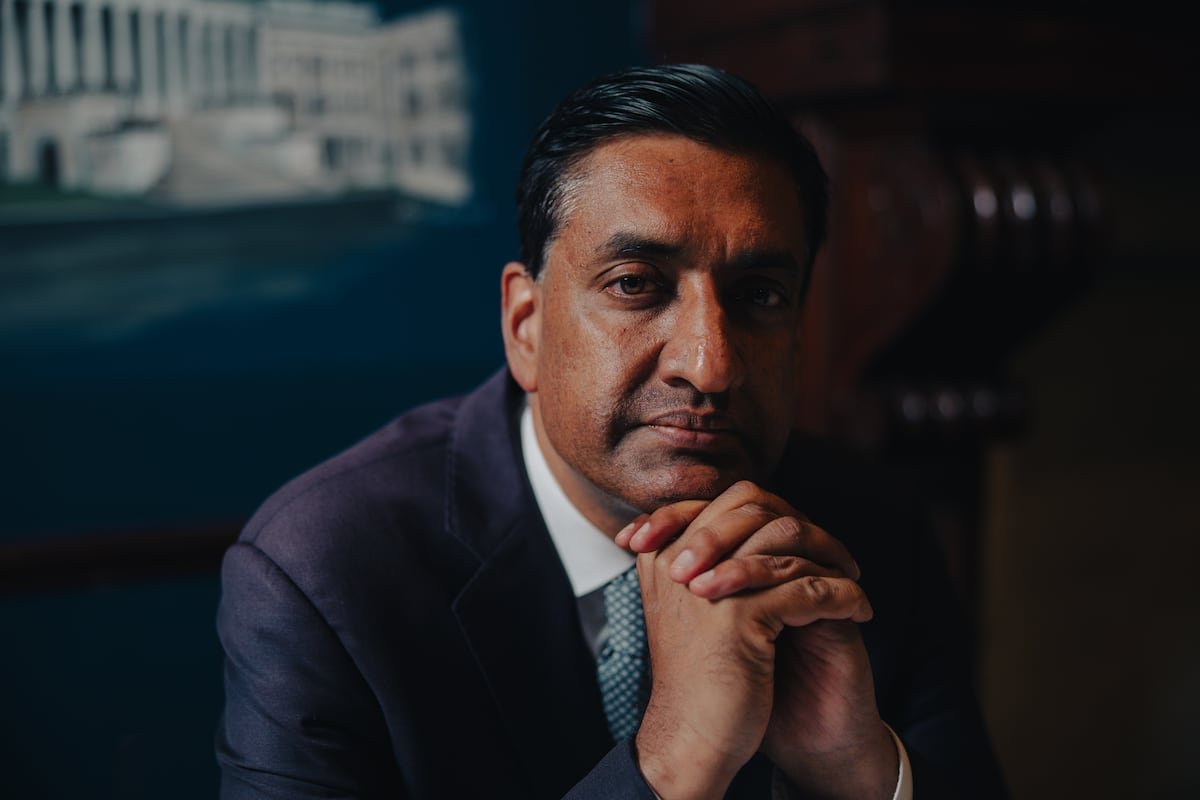
California congressman Ro Khanna, 49, recently urged on a podcast for Elon Musk “to answer” for the “4.5 million children around the world who he possibly sentenced to death by dismantling [the U.S. Agency for International Development] USAID.”
The Democratic representative from Silicon Valley was referring to the role played by the world’s first trillionaire as head of the Department of Government Efficiency (DOGE), the cost-cutting initiative he led for several months at the behest of U.S. President Donald Trump. The estimate of 4.5 million deaths comes from a scientific paper published in The Lancet in 2025.
Following the podcast, Musk lashed out on his social media platform X before his 240 million followers. He threatened to sue Khanna and said the congressman “should be in prison.” He also accused the congressman — who has promoted a bill to levy an annual 5% tax on fortunes over $1 billion — of profiting on the stock market with insider information obtained through his work in Congress.
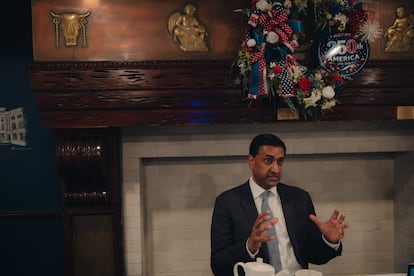
The following day, Khanna, the son of Indian immigrants, met with EL PAÍS at the National Democratic Club, a members-only venue in the shadow of the Capitol. Even before his clash with Musk, the unabashed progressive had seen his national profile rise sharply through his campaign alongside Republican congressman Thomas Massie to force the release of files related to the late financier and convicted sex offender Jeffrey Epstein.
Together, they succeeded in passing legislation requiring the Trump administration to declassify those documents, a process that remains incomplete. Khanna also sits on the House Oversight Committee, which is conducting its own investigation. Among the figures who have appeared before the committee to explain their connections to Epstein are Bill and Hillary Clinton, Bill Gates, former Attorney General Pam Bondi, and Commerce Secretary Howard Lutnick.
Khanna has said he does not rule out using his growing visibility to run for president, though he insists he does not want to get ahead of himself. First come the midterm elections next November, in which he is convinced Democrats will win back the House of Representatives “decisively” and may even capture the Senate, which he describes as “a toss-up.”
Should those predictions come true, Khanna foresees a second half of Trump’s term marked by confrontation from Capitol Hill, aimed at containing what he sees as the president’s authoritarian drift and “stopping his corruption.”
Question. How do you feel about being threatened by the world’s first trillionaire?
Answer. I’m less concerned that the richest man in the world is threatening me, and I’m more concerned that the richest man in the world made decisions that hurt the poorest people in the world. I simply cited a study and said that Musk needs to explain what he did [while leading DOGE]. He responded with threats and intimidation. He’s afraid. He doesn’t want to be held accountable when the Democrats take back office. He knows we will win in November and that we will subpoena him.
Q. How do you respond to his accusations?
A. They are lies. In Congress, I have led the fight to ban members from profiting from the stock market. My wife’s assets [an accomplished investor with substantial wealth] predate our marriage and are held in a trust, exactly as the law I propose requires. He’s clinging to that, but it has no basis. No Democrat has been more successful in actually landing a blow to the Trump coalition thanks to the Epstein files, so I also have experience facing the president’s attacks. Harassment and threats don’t worry me — I’m used to them. They’re not going to silence me.
Q. Should one person be allowed to amass as much money as Musk?
A. It’s proof the system is unfair because it does not tax capital gains as ordinary income. If it did, he wouldn’t be so wealthy. It’s because there are companies that don’t pay taxes, and because stock buybacks aren’t taxed as income either. We don’t have proper collective bargaining rights or a livable wage. I have no problem with Musk building wealth, but he should also help support the success of every American.

Q. People often draw a parallel between today’s era and that of the robber barons, the magnates who a century ago amassed enormous wealth and influence.
A. This is worse. The wealth of 19 billionaires is three times that of Rockefeller, Morgan, Carnegie and Vanderbilt combined. Today’s 19 billionaires have the wealth equivalent to 12% of GPD and, unlike a century ago, they’re not building universities or hospitals. That’s why we need a new social contract in the United States. My bet is on a new economic patriotism: tax these multibillionaires, provide Medicare for all, free public college…
Q. Is the U.S. system ready for that?
A. We will require a candidate to run on a bold platform like Franklin D. Roosevelt, Lyndon Johnson or Bernie Sanders. The time is now ripe for that. With the oligarchy in full display, Trump’s rampant corruption and brutal wealth disparity, I think the country is ripe for another New Deal-like moment
Q. As a congressman from Silicon Valley… did you see the rightward shift of its leaders coming?
A. I did not. That rightward shift is limited to a minority — albeit a vocal one — steeped in a libertarianism that wants government kept out of the way and in a rejection of the multiracial democracy that is the essence of the United States.
Q. How many of the Epstein files remain to be revealed?
A. Around three million, many of them the statements victims gave to the FBI about the men who raped, abused and trafficked them.
Q. Will they be declassified?
A. Eventually. They will certainly be released when we have a Democratic president, but will they be released before then? The fight will be hard. We have to secure a commitment to release the remainder of the records before confirming Todd Blanche as attorney general. He must also commit to prosecuting and investigating the people named in them, such as [investor] Leon Black or [the former owner, among others, of Victoria’s Secret] Les Wexner.
Q. The Epstein files have had greater consequences abroad. What makes the U.S. system so protective of powerful men?
A. Money has hijacked politics in the United States. [The Epstein case] has gone after the donor class [those who funnel money into campaigns]. That is why both parties have done so much to silence the issue. I’m also talking about Gates and Reid Hoffman, two major Democratic backers. Massie and I don’t care where the evidence leads, even if it hurts our allies. We want justice.
Q. It seems Trump’s strategy of delaying the files’ release is working…
A. It’s true Americans have a short attention span, but we mustn’t forget this matter broke Trump’s coalition. It opened the door for Republican members of Congress to oppose him on issues such as the war in Iran. When the history of his second presidency is written, the Epstein files will be seen as the blow that began his decline. It reminded his base that Trump — who was friends with Epstein for 15 years — is part of the system he promised to expose.
Q. Is the possibility that Epstein did not kill himself being considered by the House Oversight Committee?
A. We are investigating it. Julie Brown, one of the best journalists on this topic, says she doesn’t know definitively. There are unanswered questions.
Q. You are confident that Democrats will win in November, but who will win the battle for control of the party? The establishment, or the socialists gaining ground in the wake of New York Mayor Zohran Mamdani’s rise while Trump stokes fears of a communist collapse?
A. The party needs to jettison the establishment and forge a progressive future, to stop being beholden to big corporations. That fight will happen after 2026.
Q. Who is the leader of the Democrats now?
A. There isn’t one. One will emerge when we have a Democratic nominee in 2028.
Q. Is the United States ready to elect a candidate of South Asian descent like you?
A. I would love to see a Latino president, and I think it will happen in the next decade. It is the fastest-growing demographic. A president of South Asian origin is also an option. Children of immigrants understand the hunger for hard work and economic opportunity. And we understand what immigration means for the American dream. So I expect Latino presidents, South Asian presidents and presidents from all backgrounds. That’s the greatness of America’s story.
Q. There is growing racism, especially in the MAGA movement, against your community…
A. There is a backlash against all communities of color, because people are afraid of what a multiracial America looks like. But if we can show them that they have an economic future and that their kids do, then we can lessen that hatred.
Q. Did you agree with the conclusions of the autopsy commissioned by your party into Kamala Harris’s defeat?
A. It was not done well. They needed to talk about the genocide in Gaza, which was a huge issue of why we lost. Also, we did not send a clearer message of taking on the oligarchy or explain why we lacked a concrete proposal to help the working class.
Q. As someone who introduced an initiative to recognize Palestine as a state… do you think Israel will again be a decisive issue in the November elections?
A. Yes, because it’s a moral test. If you do not acknowledge that a genocide is occurring when you are seeing it with your own eyes, and that information reaches people through their phones, you risk voters questioning your decency. There are no longer excuses. We have just seen the U.N. publish a report stating that 20,000 Palestinian children were killed — and that Israel did so using deliberately high-impact bombs.
Q. This Saturday the United States celebrates the 250th anniversary of the Declaration of Independence. What shape are the country’s founding ideals in as it reaches that milestone?
A. I was born in 1976, the bicentennial year, in Philadelphia — the city where the Declaration of Independence was signed. I am the son of Indian immigrants who arrived in the 1960s. If you had asked my parents whether they thought their son would become a congressman representing the richest district in the world, they would have called you crazy. So the United States is making progress in spite of ourselves. We have people of every background and faith in the Capitol. It is unprecedented. There has never been a decent multiracial democracy in the history of the world.
Q. Trump does not seem to agree with that.
A. Trump’s rhetoric represents an ugly appeal to a nostalgia that denies progress is linear. These years will be remembered as an interlude. We will overcome it. The question is how long it will take. I do not expect it to take 100 years — which was how long it took to move past the Jim Crow era.
Sign up for our weekly newsletter to get more English-language news coverage from EL PAÍS USA Edition