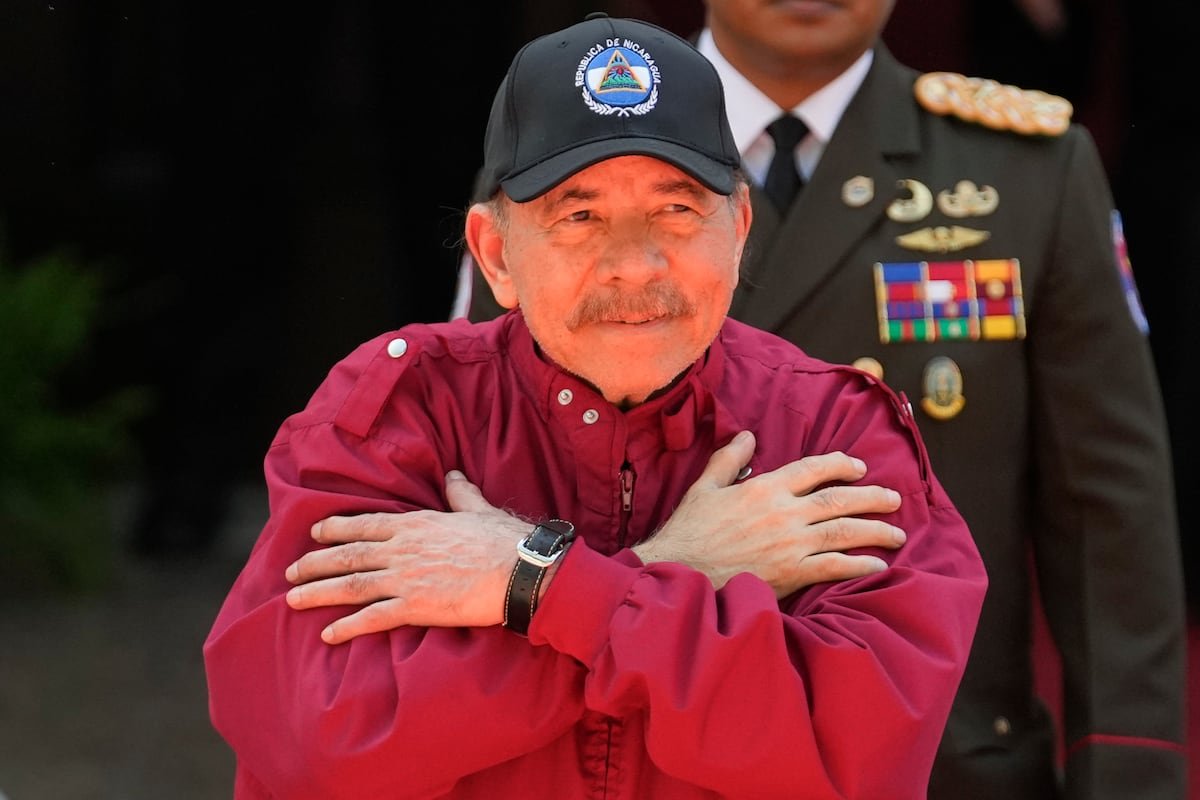
Former guerrilla fighter and Nicaraguan historian Mónica Baltodano — who risked her life in her youth to overthrow the Somoza dictatorship — was stunned by the announcement made by Daniel Ortega on July 19: “I first reacted with astonishment. The elections they have organized have been questionable, if not clearly fraudulent, for decades, so the words were nothing more than an expression of the brazenness with which they have been running the government for some time,” says the ex-guerrilla commander, who is living in exile in Costa Rica.
That the death sentence for electoral processes was pronounced precisely on the day that commemorates the triumph of the Sandinista Revolution completed the bitterest irony: the same date that in 1979 promised the birth of democracy in the country served, almost half a century later, to definitively bury its last vestiges. Ortega is not only placing a tombstone on Nicaragua’s already drowned democracy, he is also cementing the region’s last dictatorship, sealing the country’s autocratic drift and paving the way for a new family dynasty. “It is the antithesis of what that struggle meant, of the aims and commitments of a fight that cost so many lives. Announcing that on the anniversary of the end of a dictatorship is like a mockery,” Baltodano says.
Over nearly two decades in power, Ortega has consolidated his autocratic regime through a gradual strategy of institutional capture and systematic repression. He has co-opted the independence of the judiciary, the Supreme Electoral Council, and the National Assembly. He pushed constitutional reforms to eliminate term limits and establish his indefinite reappointment. Recurrent fraud and the outlawing of opposition parties have been his means of undermining elections. The elderly former guerrilla, now 80, also implemented a de facto police state after the violent repression of the 2018 protests that demanded an end to the regime.
Ortega imprisoned the main presidential pre-candidates, civic leaders, journalists, and members of the Catholic Church prior to the 2021 elections, which he said he won with more than 75% of the vote. He also ordered the mass closure and confiscation of NGOs, media outlets, and independent universities. He has stripped thousands of dissidents — labeled “traitors to the homeland” — of their citizenship and rights and forced them into exile. All of this has resulted in the absolute centralization of power alongside his wife and co-president, Rosario Murillo, who has styled herself the regime’s heir.
For Baltodano, Ortega’s latest move is nothing more than formalizing what in practice was already in operation. However, she warns that the legal engineering the regime plans to use to finalize the autocratic model remains to be seen, comparing it to totalitarian schemes such as North Korea’s. The National Assembly — Nicaragua’s parliament, completely controlled by Ortega — is preparing to approve the constitutional reforms necessary to implement the leader’s plan to end elections. “Democracy in Nicaragua no longer exists, but this is the final nail in the coffin. I still have doubts about the route they will take. It could be the creation of sham bodies, like a large assembly that ratifies Ortega in power but that really doesn’t function as such, and is a masquerade,” Baltodano says.
The historian emphasizes that the underlying aim is not only to neutralize any vestige of institutionalism, but to definitively strangle the opposition in exile and those stripped of their nationality. “What is beyond doubt is that whatever they propose will serve a purpose: to guarantee perpetuity or to make it even harder to remove them from power. They want to create an absolute impossibility for the opposition in exile to have any chance of considering participation in elections,” she explains.
Family succession
With the opposition totally blocked under a regime without elections, the question generating the most debate is the process of familial succession of power. Although Ortega said he expects to govern for another 10 years, his advanced age raises doubts about his real ability to remain at the head of the regime. That leaves his wife, the esoteric Murillo, who has long yearned to rule Nicaragua. After her come their nine children. On the feasibility of imposing the presidential couple’s offspring in power — in a dynastic style reminiscent of the Somoza dynasty they once fought — Baltodano notes important qualifications: “I don’t think conditions exist for the army to accept a dynastic dictatorship inherited by the children,” she says.
So far the Nicaraguan military has maintained an unbreakable loyalty to Ortega, despite Murillo having launched a purge against key figures tied to the military apparatus, such as Bayardo Arce Castaño, one of the nine commanders of the Sandinista revolution and historically close to Ortega, or Humberto Ortega, former military strategist of the Sandinistas and army chief who died in 2024 at 77 years of age while held under house arrest by his older brother and sister-in-law.
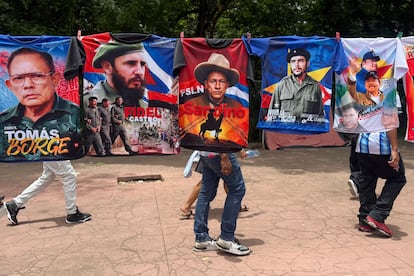
Despite the repressive apparatus and the image of monolithic control, Baltodano stresses that within the state structure, the police, and the armed forces, there is a latent discontent that the regime only manages to contain through coercive subjugation. “They are operating through terror, but discontent exists. I do not doubt there are disagreements within the military, the police, among state employees. There is no way this can be sustained for long without new outbreaks of rebellion,” the historian predicts.
Orlando Pérez, professor of political science at the University of North Texas at Dallas, stresses that the Ortega–Murillo plan seeks to establish the line of succession in the co-president and, later, in their children, particularly Laureano Ortega Murillo, the regime’s liaison with the governments of Russia and China. However, he warns that the viability of a family dynasty runs into a key domestic actor: the armed forces. “The question I ask, and that many analysts ask, is whether the Nicaraguan army would allow that succession. I think it is the only institution within Nicaragua that could ultimately act as some moderating power,” he says.
Despite that potential role, the political scientist clarifies that the military institution has suffered a constant degradation in its autonomy: “Ortega and Murillo have purged the vast majority of high- and mid-ranking officers and have hollowed out the army’s professionalism, creating a force bent and subordinated to the family. Today they are totally subordinate to the regime.”
At the center of succession bets is a system unique in Latin America: a country governed by a family, a situation not seen for several decades when the region was ruled by military regimes. “Nicaragua is a sui generis case,” says Katya Salazar, executive director of the Foundation for Due Process, based in Washington. “I think in other eras of history it could be classified as a monarchy, because it is not government. The presidential couple does what they want and this decision that there will be no more elections is part of that madness,” she asserts.
The Washington paradox
Ortega’s definitive blow to democracy comes in a turbulent regional context, with pressure from the administration of U.S. President Donald Trump on neighboring regimes such as Cuba’s and a complex international scenario. However, what stands out is Washington’s tepid reaction to Ortega’s new escalation. Baltodano points to a cold calculation by the U.S. leader: “The calculation is precisely that Nicaragua is not in the international spotlight. It has completely fallen to the background. Ortega saw, for example, that the United States has no problem dealing with dictators in Venezuela, as long as their economic problems or control over oil are resolved.”
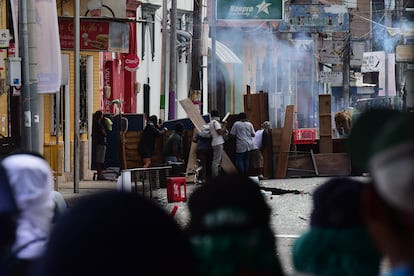
Unlike other crisis hotspots in the region or the Middle East, Nicaragua currently occupies a secondary place on the U.S. diplomatic agenda. According to Pérez, the U.S. government faces pragmatic limitations and contradictions in its dealings with Managua, where rhetoric clashes with areas of functional cooperation. “The U.S. government and Nicaragua’s government continue to cooperate, for example, on migration. In addition, the United States buys gold from Nicaragua, which is an important export, and Nicaragua remains a CAFTA-DR member,” the specialist explains, referring to the free trade agreement between the U.S., Central America, and the Dominican Republic.
According to Pérez’s analysis, the only major punitive measure left for Washington would be to expel Nicaragua from that agreement, although it is an option with undesirable side effects for the entire region. “That is the last lever that can be pulled, but it would have repercussions not only on Nicaragua but on the other members. It would sharply affect maquila workers, the textile supply chain in Honduras, Nicaragua, and Costa Rica, and create strong migratory pressures. That is why I see it as difficult,” he says.
Added to this is a weighty sociopolitical reality in the United States: the Nicaraguan diaspora lacks the electoral muscle and influence enjoyed by Cuban or Venezuelan communities in Washington and in key states such as Florida.
Katya Salazar also asks what measures the United States can take when its government repeatedly states an intention to end authoritarian regimes in the region. “The question is whether the United States follows the Monroe Doctrine — or Donroe now, as it has with the rest of the region — and whether it will decide to do something like it did in Venezuela. Nicaragua survives thanks to trade with North American countries. Is the United States willing to cut that off, to affect that? Is Canada willing to limit that?” she asks.
While the U.S. government is stretched across multiple fronts (Iran is a nightmare that could ultimately hurt Trump with voters), Ortega has managed to impose his one-party, family regime without resistance. The last dictatorship in Latin America. “What happens in Nicaragua is a case far removed from the rest of the region. I would say it is more a case for psychiatry,” says Salazar. In a world whose eyes are on other crises, Salazar does not rule out that Ortega could get away with it. “This will end the day those characters die,” she concludes.
Sign up for our weekly newsletter to get more English-language news coverage from EL PAÍS USA Edition