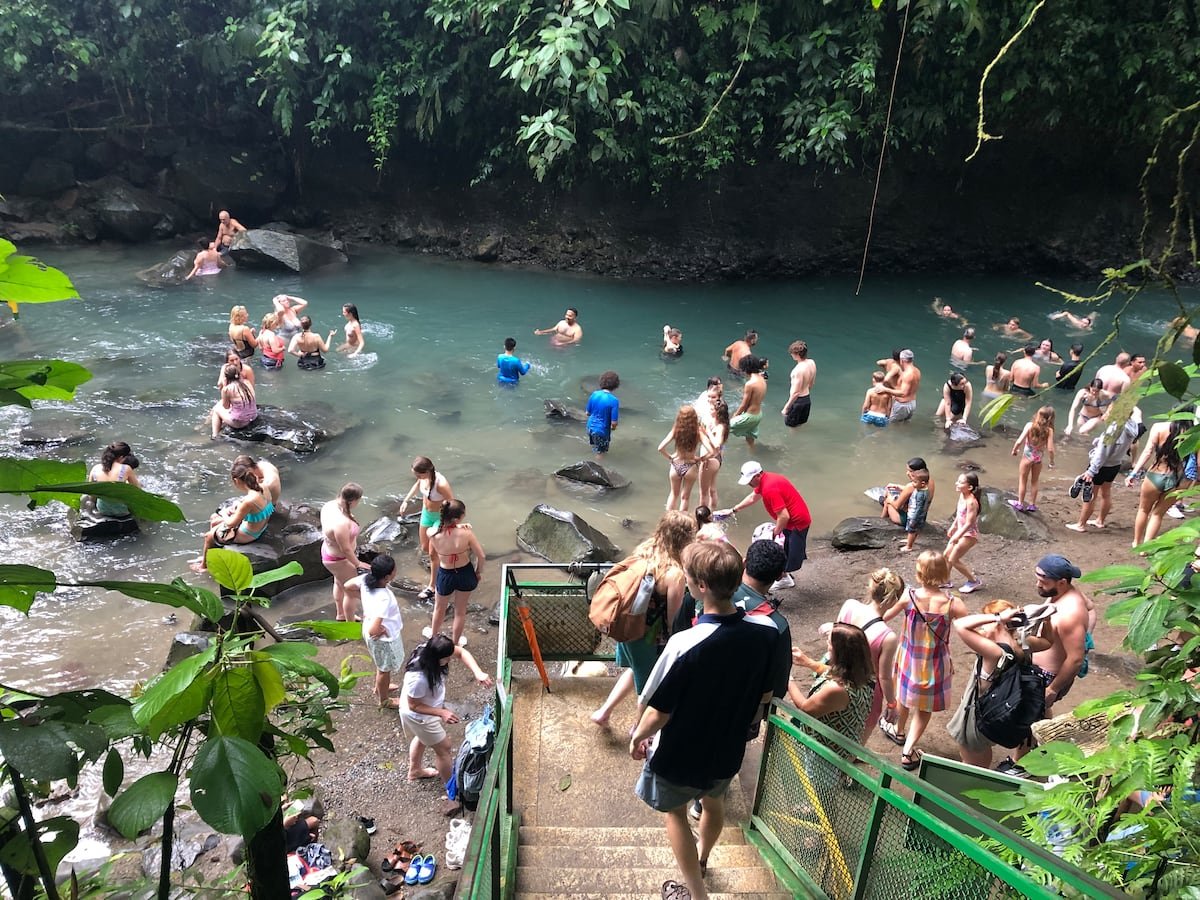
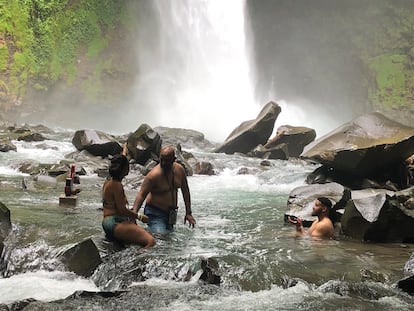
Dozens of foreign tourists splashed at the base of a waterfall over 70 meters high amid the humid jungle, experiencing the primitive thrill of bathing in a pristine river alongside fish the length of a foot, under a warm drizzle and a stray ray of sun that completed the postcard scene. No one seemed worried about the 500 steps they would have to climb afterward to leave the site, which this year entered the top 1% of the best places to visit in the world, according to Tripadvisor. An Irish woman meditated to connect with the fibers of nature, two young Indians made a video call to their mother to tell her they had reached the waterfall she had recommended near the Arenal volcano, and many others filled their phones with images that would later invite more people to come, as about 350,000 do each year. But this is not just another business.
Almost half of the travelers who pass through La Fortuna, the most-visited town in Costa Rica, come to the waterfall. Costa Rica is the Central American country where ecotourism has established itself as a flagship, profitable industry thanks to a broad network of private businesses. This site, however, is owned by a community association and the profits will not end up in the accounts of an entrepreneur, international chains, or the state.
While dozens of foreigners swam in the river, a dozen elders from the community were doing so in the town’s semi-Olympic pool built with the waterfall’s earnings, as happens with other communal infrastructure, ornamental services, cultural investments, and social aid managed by the Asociación de Desarrollo Integral de La Fortuna (La Fortuna Association for Comprehensive Development, Adifort), a private non-profit organization with a public interest mandate. Almost none of the thousands of visitors who selected the La Fortuna waterfall on Tripadvisor as a favorite popular destination knew this, according to the notification the association received at the end of April.
Yeray Macías, a Spanish veterinarian who arrived with his family looking for nature, dense greenery, and clean rivers, was also unaware — although while he photographed the waterfall fed by late May rains he was pleased to learn that this destination is different because of its ultimate beneficiaries. None of the visitors would necessarily have heard that it all began with a destructive eruption of the Arenal volcano in 1968 and the state’s intention to keep the population in the area.
Locals received land in the 1970s to farm, but one man was granted this broken piece of volcanic wall and saw no use for crops or livestock, so he donated it to the community association. Over time, locals and foreigners alike experienced the extreme trek, walking for hours on muddy trails and descending on vines or ropes to the place that now, with La Fortuna turned into the country’s tourism hub, can be visited by almost anyone with the addition of improved access, safety, and complementary services.
“We are glad this stays with the community,” Macías says, pleased that his online search led him to a town set up to combine nature with good tourist facilities. Hundreds of hotels, restaurants and attractions with English-language adverts are part of the landscape marked by the conical silhouette of the Arenal volcano, which sometimes appears fully between the clouds and until recently put on an incandescent show when it erupted at night. Adifort takes advantage of this. “It’s as if they hacked the industry, intruders in the system,” says Mark Rodríguez, a young tourist from New Jersey, laughing as he tries to understand how an operation run by a community organization with nearly 500 local members works.
“We receive state support, but 95% of our resources come from our own management. That allows us to invest in the district (with 15,000 inhabitants) in many ways, largely thanks to what each tourist pays to visit Catarata Río La Fortuna,” José Eduardo Jiménez, Adifort’s commercial director, told EL PAÍS. The association also owns a shopping center, the bus station, the soccer field, and even the town’s central square with its own private security. “They call it ‘Mamá Adifort,’” adds Humberto Mora, the association’s vice president. Adifort manages assets worth nearly $44 million thanks to activities such as the waterfall that appears on thousands of travelers’ social media accounts across dozens of countries.
“It makes us feel very good because it promotes conscientious tourism, not just support for nature and conservation […] We show that other towns could do it too,” Jiménez added, surrounded by tourists who seemed to be enjoying the rain. The association trusts that travelers will continue to arrive in large numbers to La Fortuna, drawn by hot spring businesses, adventure attractions and the network of tourist services. It benefits from the total number of visitors Costa Rica receives, which has been growing year-on-year since the pandemic, with no apparent impact from rising insecurity or higher prices compared with other tropical destinations in the Americas. That is why they recently bought new land next to the waterfall and plan to build a glass bridge in front of it, a unique structure in the country.
“We are honoring the legacy of the leaders who founded the town and the association. This is our goose that lays the golden eggs. We know how to generate revenue and channel it for the benefit of people, taking advantage of an activity that is very much ours,” Mora says, referring to cultural factors that encourage communal investments without depending on the government.
Travelers perceive that image, like Keyla Rodríguez from Puerto Rico, who spends much of the year traveling to different countries. “They have very good access and services without losing the natural feel. The guide told us this morning that it belongs to the local people and you can see how they care for it,” she said. The association also plans to create an itinerary so visitors can learn about communal works and better understand where they are — for example, passing by the town cemetery to see the common grave where the bodies of those who died in the eruption that helped turn La Fortuna into what it is today are buried.
Sign up for our weekly newsletter to get more English-language news coverage from EL PAÍS USA Edition