The Argentine collective joy after winning the Qatar World Cup in 2022 was played out to a soundtrack that began like this: “In Argentina I was born, land of Diego and Lionel, of the lads from the Falklands I will never forget.” Four years later — in the attempt to win a fourth star in the tournament held in the U.S., Mexico and Canada — Messi, Maradona and the islands shared verses again in a new Argentine soccer anthem: “For the Falklands, for Diego, for Leo’s last one, Argentina, I want to see you two-time champion.”
In Argentina, soccer and nationhood go hand-in-hand. There is no greater or more popular nationalist cause here than regaining the islands that have been a British Overseas Territory since 1833. The Falklands, which are known in Argentina as Las Malvinas, awaken a mix of pride, pain, and belonging, but they also create a consensus that turns them into a readily available political resource to shift attention when reality becomes uncomfortable, as Javier Milei has just done.
Why do the Falklands occupy a central place in the Argentine imagination? Some researchers say you must go back to Argentina’s founding narrative and its thwarted destiny — the story that nostalgically recalls that the country was once powerful and prosperous and then ceased to be.
“When Argentina emancipated itself from Spain, the Falklands were part of it and then they were stolen from us, and that ties into Argentina’s trauma — to what it could be and is not,” says political scientist Mariana Altieri, author of the book Malvinas y Gibraltar, conflictos atrincherados (The Falklands and Gibraltar: Long-Standing Conflicts). She recalls that from the start of the British occupation successive governments and major literary figures such as José Hernández, author of Martín Fierro, demanded Argentine sovereignty over the islands. “Those rights never expire,” Hernández wrote in 1869.
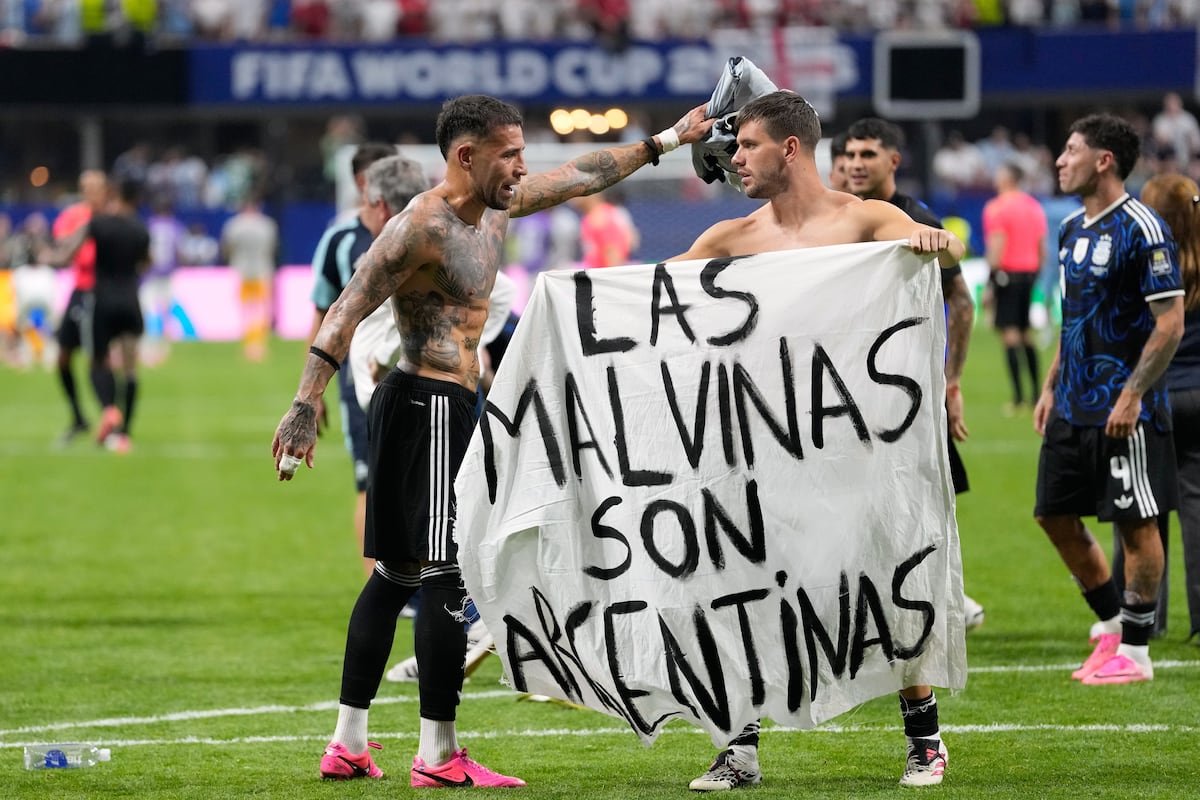
“The farther the idea of recovering them recedes, the more the logic of revenge grows,” Altieri continues, noting that soccer has been one of the arenas where that revenge has been possible symbolically. The most remembered instance came in 1986, only four years after the Falklands War, when Diego Armando Maradona scored one goal with his hand and another after dribbling past five English players and the goalkeeper in what was dubbed “the goal of the century.” The latest meeting, in 2026, in the World Cup semifinal, featured his heir, Lionel Messi, as captain of the Albiceleste in a comeback 2-1 victory. The euphoria that greeted the second goal in front of every television in Argentina increased at the end of the match, when some players unfurled a homemade flag on the pitch that read “Las Malvinas son argentinas” (The Falklands are Argentine). No one cared about the expected FIFA sanction.
Anthropologist Rosana Guber, one of the country’s leading specialists on the Falklands War, says it was “obvious” there would be some political claim during the match. “The players were a channel. The protagonist was a guy at the hotel who grabbed a sheet and painted the slogan on it. He was nobody. Or he was everyone. Because what he did was shout that we beat the British, that we have rights over the islands and that we must be recognized,” Guber says.
A professor and senior researcher at the National Scientific and Technical Research Council (CONICET), Guber believes that the feeling the Falklands provoke in Argentines can be understood if they are seen as a symbol. “A symbol like the flag, the national anthem, or the cross. And symbols have different meanings, not just one. They speak to people who can hold very different positions on everything. That was the point Milei appealed to the other day, saying: ‘On this we are all together.’ Just like in 1982,” she notes.
Of all its multiple meanings, Guber highlights three: the outstanding sovereignty issue that Great Britain refuses to negotiate with any Argentine government; the popular cause that claims the Falklands from soccer stands, parades, demonstrations and any other setting; and the 1982 war, to which the dictatorship sent thousands of conscripts aged 19 and 20 and which caused the deaths of 649 Argentine combatants and 255 British servicemen.
An omnipresent emblem
Historian Esteban Rodríguez lives in Río Grande, the city closest to the Falklands. It is less than 600 kilometers (370 miles) away, compared with the nearly 12,800 kilometers (7,950 miles) separating the islands from the British coast. The province that includes Río Grande, Argentina’s southernmost, is called Tierra del Fuego, Antarctica, and the South Atlantic Islands, and the outline of the islands appears on every Fuegian student uniform, on all of the local soccer clubs’ kits and on numerous murals and plaques. The provincial anthem is the March of the Malvinas. Children learn it from the moment they enter school: “Behind their misty quilt / We shall not forget them / The Argentine Falklands / Claims the wind and roars the sea.”
It is easy to understand why, Rodríguez says, because the Falklands are an inseparable part of Argentine identity, especially in the south. “We feel the Falklands as a loss and it is a loss that has been seared into us because we are reminded of it all the time,” the historian says. That feeling deepened after defeat in the war declared by the dictator Leopoldo Fortunato Galtieri.
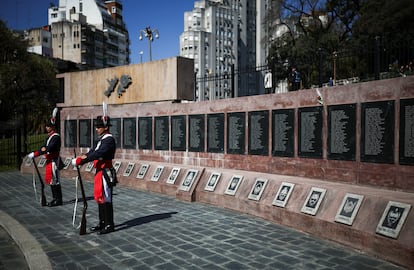
Río Grande was the main city in the conflict. Super Étendard jets took off from there to bomb British ships. After the defeat, every April 1, on the eve of the day the war began, a vigil is held to pay tribute to the fallen and keep the memory alive. The tribute continued despite the de-Falklandization policies imposed in the 1980s and 1990s, when veterans maintained the cause against the tide. Today, despite low temperatures and the nearly constant icy wind, “the vigil can bring together up to 20,000 people,” Rodríguez says.
Unknown islands
Journalist Nicolás Cassese has just published the novel Puerto Stanley, 1982 and has traveled to the Falklands three times as a reporter for the newspaper La Nación. He believes many Argentines know little about the islands beyond the dispossession in 1833 and the war a century and a half later: “The latest resurgence of Argentine nationalism rests on the triple M — Messi, Maradona and the Malvinas — but we have an enormous amount of information on the first two and almost nothing about the Falklands,” Cassese says.
As an example, he recalls that when he published the novel some friends asked about the title because they did not know what Puerto Stanley referred to and some even associated it with a well-known brand of thermoses. They were unaware that it is the name the British use for the largest town in the archipelago, Port Stanley, known on Argentine maps as Puerto Argentino. Although he was accused on social media of being a traitor, he explains that the town was founded in 1845, when the British already controlled the islands, and that Argentines themselves used that name for decades. Also little known are the strong cultural and commercial ties that once existed between the Falklands, Tierra del Fuego, and the far south of Chile. “The first sheep brought to Santa Cruz at the end of the 19th century came from the Falklands,” he says by way of example.
Knowledge about the islands is rarely firsthand. Fewer than 1% of Argentines have visited the Falklands. The journey is very expensive, requires staying at least a week and accepting that your passport will be stamped. Yet they are an indispensable part of the historical construction of national identity. “In the 19th century, Argentina was a new country with many immigrants who spoke different languages, and education was crucial to creating a common identity. The Falklands were part of that narrative,” Cassese says. Others, like Guber, believe the school’s role was lesser than often claimed, even minimal.
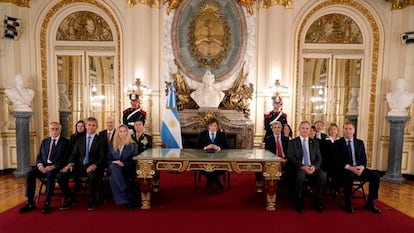
Experts speak of the Falklands as a symbol, a place of mourning and an open wound. But the islands are also one of the few points of unity in a society split in two. That unity has made them politically useful on numerous occasions. Milei took advantage of a remark by Donald Trump that hinted the United States might revisit its historic neutrality in the sovereignty dispute over the islands to defend, on national television, the statement “the Falklands are Argentine.” In his speech, which ended with “viva la patria” (long live the homeland), he announced sanctions against companies operating in the area without Argentine authorization and promised to build a military base in the south.
Given that a 2011 law already imposes those sanctions and that construction of the announced base had already begun before he halted it, the opposition accused him of opportunism and of “galtierizing” the cause, in reference to the former dictator. The La Plata Veterans’ Center (CECIM) branded Milei a hypocrite and criticized his use of the Falklands as a “life preserver to hide his miseries.”
Cassese, by contrast, argues that “for Milei embracing the Falklands cause is all gain” and notes that with it he shields “one of his weak flanks; the accusation of being a sellout,” since he has tried to reform the law that caps foreign ownership of land.
Argentina’s foreign policy on the Falklands has swung for decades between confrontation and attempts at rapprochement. Altieri believes Milei has so far chosen the cooperative line, like Mauricio Macri before him. In 2025, Milei expressed support for self-determination for the Falkland Islanders: “We hope that the Malvinas people will one day decide to vote with their feet for us. That is why we seek to make Argentina such a power that they will prefer to be Argentines.” By contrast, his televised speech on Thursday “was a 180-degree turn,” says Altieri.
While Milei’s economic course divides society, “the announcement of sanctions, of imposing costs on the British, generates a lot of support; the majority agree that that is what must be done,” Altieri adds. In his third year in office, Milei has just discovered the power of a flag that transcends the divide.
Sign up for our weekly newsletter to get more English-language news coverage from EL PAÍS USA Edition