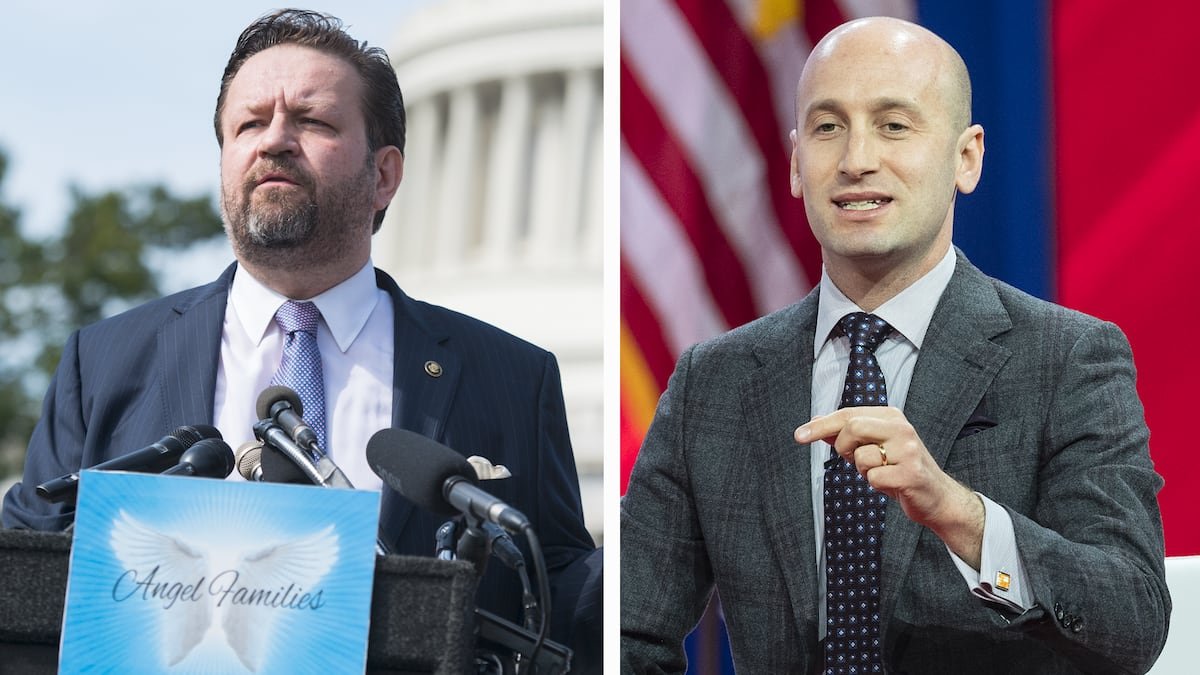
At the helm of the pressure strategy on Mexico designed in Washington, on the hard-line side, there are two individuals: Stephen Miller and Sebastian Gorka. They are two well-known figures from Donald Trump’s circle of loyalists, both allies of his during his first presidency and whom the president recruited as soon as he secured a second term.
Miller, White House deputy chief of staff for policy and homeland security advisor, is the better-known of the two, and is noted for his aggressive style and for serving between 2017 and 2021 as the architect of Trump’s most xenophobic policies.
Gorka worked for only seven months during Trump’s first term — enough time to advocate for the controversial ban on seven majority-Muslim countries that marked Trump’s debut in the White House. He also helped introduce into the MAGA movement an idea that has since become central to its rhetoric: that Islam is an existential threat to Western civilization.
After years as a MAGA media commentator, Gorka has returned to frontline politics as senior director for counter-terrorism on the National Security Council. In that role he has helped craft a newly successful strategy: making the fight against “narco-terrorism” a priority in Latin America, while framing criminal organizations involved in drug trafficking as an imminent threat to national security.
Part of that plan has involved adding some of those cartels to the State Department’s list of terrorist organizations. It has also led to a campaign of extrajudicial military operations that has already claimed the lives of more than 200 crew members of alleged drug-running speedboats in Caribbean and Pacific waters.
Since the arrest on January 3 of Venezuela’s Nicolás Maduro, who is awaiting trial in New York on drug-related charges, and with the machinery to strangle Cuba running at full speed to force change on the island, Mexico — long present in U.S. calculations — appears to have gained prominence in the priorities of the White House’s new Monroe Doctrine of interventionism, with moves such as the Department of Justice charging the governor of Sinaloa, Rubén Rocha, and nine other senior state officials of links to a faction of the Sinaloa Cartel.
Faced with rising tension in bilateral relations and with Trump’s strategy — the U.S. president has not concealed his wish for a military deployment and is pressing for cooperation against the cartels with neighbors such as Honduras and Guatemala — Mexican President Claudia Sheinbaum asked at a mass event last Sunday: “Is this really a legitimate interest in fighting organized crime, or are they trying to influence the 2027 election in our country?” Sheinbaum was also alluding to the increasingly evident alliances between the MAGA movement and Mexico’s far right.
“All of Miller’s obsessions converge on Mexico,” says a Washington source familiar with the bilateral relationship, listing the administration’s black marks and priorities that include irregular immigration, drug trafficking, and reaffirming U.S. national identity. “And to strengthen his hard-line stance the success of the narco-terrorism concept is essential, the reconceptualization of the so-called war on drugs that allows them to direct intelligence and military resources at it,” the source adds.
Fundamentalism in the background
After years in which Islamist terrorism was the primary U.S. concern — and as the country approaches the 25th anniversary of 9/11 — narcotrafficking moved to the top with the May publication of the U.S. Counterterrorism Strategy, which also takes aim at (and equates jihadism with drug mafias) a supposed domestic enemy: “Violent secular political groups whose ideology is anti-American, radically pro-transgender, and anarchist.”
After the document was published, Gorka — who was born in London to Hungarian parents and has been a U.S. citizen since 2012 — told Reuters that the strategy “prioritizes, above all, neutralizing terrorist threats in the hemisphere [the Americas] by disabling cartel operations until these groups are incapable of bringing their drugs, members, and trafficking victims into the United States.”
In March, Gorka spoke at an event at the Council on Foreign Relations in Washington and offered a more theoretically elaborate justification for the pressure on Mexico than usual. “Trump believes in the Westphalian system of national sovereignty,” he said, attributing surprising subtlety to the president’s political analysis. “Imagine if Mexico operated as a fully Westphalian nation-state that exercised sovereignty in all its departments and municipalities,” the White House adviser continued. “Also, what is the other requirement of a nation-state? Not only sovereignty, but also the monopoly on the use of force. If cartels are driving heavily armored vehicles — often better armed than some units of the national armed forces — then you do not possess the monopoly on the use of force nor do you exercise sovereignty. Therefore, whether it is the United States, our allies or our partners, we cannot be safe in the field of counter-terrorism nor protect against terrorist threats if we do not understand the importance of exercising real sovereignty.»
Beyond the fight against drug trafficking — which often ignores that so much supply also responds to demand originating in the United States — the pressure on the southern neighbor is manifold. There are also tariffs, with the USMCA free trade agreement under renegotiation, and border control, a point Miller flagged from the start of Trump’s second presidency, which he likes to boast has seen “zero crossings” since he took office.
On that agenda, with different priorities acting simultaneously, “what matters on one of those fronts does not always matter in the others,” the Washington source explains. Hence the sometimes contradictory messages coming from the center of power in Washington, such as the one delivered this week by the new secretary of Homeland Security, Markwayne Mullin. Speaking to the House of Representatives, he said he had traveled to Mexico City to “talk with Sheinbaum and her cabinet about cooperation” and was “impressed that they have been very cooperative, much more cooperative than the previous administration.”
It is the old carrot-and-stick strategy, in which Sheinbaum appears to handle herself well with an administration in Washington where concessions work but where limits also exist. An administration in which two of its hard men, Miller and Gorka, belong to the group that administers the sticks.
Sign up for our weekly newsletter to get more English-language news coverage from EL PAÍS USA Edition